

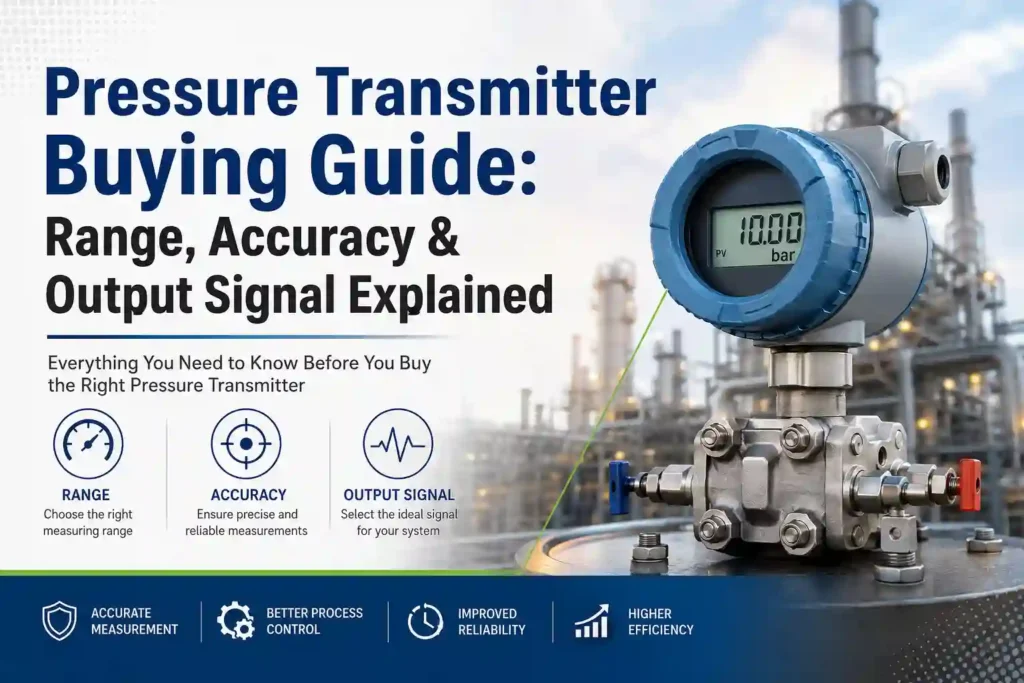
Selecting the right pressure transmitter is essential for maintaining accurate pressure measurement, reliable process control, and efficient industrial operations. Whether you’re working in oil & gas, water treatment, chemical processing, food & beverage, pharmaceuticals, or manufacturing, choosing the wrong transmitter can result in inaccurate readings, unexpected downtime, and increased maintenance costs. This Pressure Transmitter Buying Guide explains the key factors you should evaluate before purchasing a pressure transmitter, helping engineers, procurement teams, and industrial buyers make informed decisions.
What Is a Pressure Transmitter?
A pressure transmitter is a process instrumentation device that measures the pressure of liquids, gases, or steam and converts it into a standardized electrical signal. This signal is transmitted to PLCs, SCADA systems, or other industrial automation systems for continuous monitoring and control.
Unlike a basic pressure sensor, a pressure transmitter conditions the signal into an industrial-standard output such as 4–20 mA, allowing reliable communication over long distances. Depending on the application, transmitters are used to measure gauge pressure, absolute pressure, or differential pressure, making them an integral part of modern process control systems.
Why Choosing the Right Pressure Transmitter Matters
Selecting the correct pressure transmitter is about more than measuring pressure—it directly impacts process efficiency, product quality, equipment safety, and maintenance costs.
An incorrectly selected transmitter can lead to:
- Inaccurate pressure measurement
- Frequent calibration issues
- Unexpected equipment failures
- Increased maintenance expenses
- Reduced process efficiency
This Pressure Transmitter Buying Guide focuses on three critical selection factors: pressure range, accuracy, and output signal, while also covering additional considerations that influence long-term performance.
Pressure Transmitter Buying Guide: Key Factors to Consider
Before purchasing a pressure transmitter, evaluate the following specifications:
- Pressure range
- Measurement accuracy
- Output signal
- Process media compatibility
- Wetted materials
- Operating temperature
- IP rating
- Process connection
- Hazardous area certifications
- Calibration
- Long-term reliability
Considering these factors together helps ensure the transmitter delivers reliable performance throughout its service life.
Understanding Pressure Range
Pressure range defines the minimum and maximum pressure a transmitter can measure accurately. It is one of the most important specifications to evaluate when selecting a transmitter.
You should also understand:
- Overpressure: The temporary pressure the transmitter can withstand without damage.
- Proof Pressure: The maximum pressure the device can tolerate while maintaining its performance.
Selecting a transmitter with an excessively high range can reduce measurement resolution, while choosing one with too low a range may damage the sensing element during pressure spikes.
For example, if a production line normally operates between 8 and 10 bar, selecting a 0–16 bar transmitter generally provides better measurement accuracy than using a 0–100 bar model.
Pressure Range Selection Guide
| Operating Condition | Recommended Pressure Range | Why It Matters |
| Normal operating pressure | Select a range 20–30% above the maximum operating pressure | Provides accurate measurements while maintaining a safety margin |
| Frequent pressure spikes | Choose a transmitter with sufficient overpressure capability | Protects the sensing element from temporary surges |
| Low-pressure applications | Use a lower measuring range | Improves measurement resolution and accuracy |
| Wide pressure fluctuations | Select a transmitter designed for expected pressure variations | Enhances long-term reliability |
Choosing the correct measuring range is a key recommendation in any Pressure Transmitter Buying Guide, as it directly affects measurement accuracy and equipment lifespan.
Why Accuracy Is Important
Measurement accuracy determines how closely the transmitter’s output matches the actual process pressure. It is commonly expressed as a percentage of full scale.
Besides accuracy, engineers should also evaluate:
- Repeatability
- Long-term stability
- Temperature performance
For example, in pharmaceutical manufacturing, even a small measurement error can affect batch consistency and regulatory compliance. Similarly, in chemical processing, inaccurate pressure readings may result in incorrect dosing or process instability.
A good Pressure Transmitter Buying Guide recommends selecting the accuracy level based on your application’s process requirements rather than purchasing the highest specification available.
Choosing the Right Output Signal
The output signal determines how the transmitter communicates with your automation system. Selecting the appropriate output depends on installation distance, electrical noise, and compatibility with existing PLC or SCADA systems.
Output Signal Comparison
| Output Signal | Best For | Key Advantages |
| 4–20 mA | Industrial process plants | Long-distance transmission, excellent noise immunity, industry standard |
| 0–10 V | Small automation systems | Simple wiring and cost-effective for short cable runs |
| HART | Smart process instrumentation | Remote configuration, diagnostics, and calibration while retaining a 4–20 mA signal |
| Modbus | Digital automation networks | Digital communication with PLCs and SCADA systems |
In most industrial environments, 4–20 mA remains the preferred choice due to its reliability over long cable runs. HART adds advanced diagnostics, while Modbus is ideal for network-based automation systems.
Following this Pressure Transmitter Buying Guide ensures your chosen output signal integrates seamlessly with your existing control infrastructure.
Additional Buying Considerations
Beyond range, accuracy, and output signal, several other factors influence transmitter performance and reliability.
Before purchasing, evaluate:
- Process media compatibility
- Wetted materials such as stainless steel (SS316/SS316L)
- Operating temperature range
- IP rating for dust and water protection
- Process connection and thread type
- Hazardous area certifications
- Factory calibration
- Ease of maintenance
- Availability of spare parts
These specifications play a significant role in reducing maintenance costs and improving long-term operational reliability.
Common Mistakes to Avoid
Many purchasing mistakes occur because critical specifications are overlooked.
Avoid these common errors:
- Choosing the wrong pressure range
- Ignoring process media compatibility
- Overlooking environmental conditions
- Selecting an incompatible output signal
- Prioritizing price over quality
- Ignoring calibration requirements and certifications
Using a structured Pressure Transmitter Buying Guide during product evaluation helps minimize these risks and ensures better performance over the equipment’s lifecycle.
Final Thoughts
Choosing the right pressure transmitter involves much more than comparing product specifications. Understanding the correct pressure range, required accuracy, output signal, and application environment helps ensure reliable pressure monitoring, improved process control, and reduced maintenance costs.
This Pressure Transmitter Buying Guide provides a practical framework for engineers, maintenance teams, OEMs, and procurement professionals to make informed purchasing decisions. When application requirements are complex, consulting experienced instrumentation specialists can help you select the most suitable solution. As a trusted supplier of industrial automation and process instrumentation solutions in India, IPS Automation helps industries choose reliable pressure transmitters tailored to their operational requirements.
Frequently Asked Questions
How do I choose the right pressure transmitter?
Choose a pressure transmitter by evaluating the operating pressure range, required accuracy, process media, output signal, environmental conditions, and compatibility with your PLC or SCADA system.
What is the difference between a pressure transmitter and a pressure sensor?
A pressure sensor detects pressure and generates a raw signal, while a pressure transmitter converts that signal into a standardized output such as 4–20 mA, HART, or Modbus for industrial automation systems.
Which output signal is best for industrial automation?
For most industrial applications, 4–20 mA is the preferred choice due to its long-distance transmission capability and excellent resistance to electrical noise. HART is ideal for smart diagnostics, while Modbus is suitable for digital communication networks.
Why is transmitter accuracy important?
Higher accuracy improves product quality, process efficiency, and operational safety by ensuring precise pressure measurement. Accurate transmitters also reduce process deviations, maintenance requirements, and production downtime.