

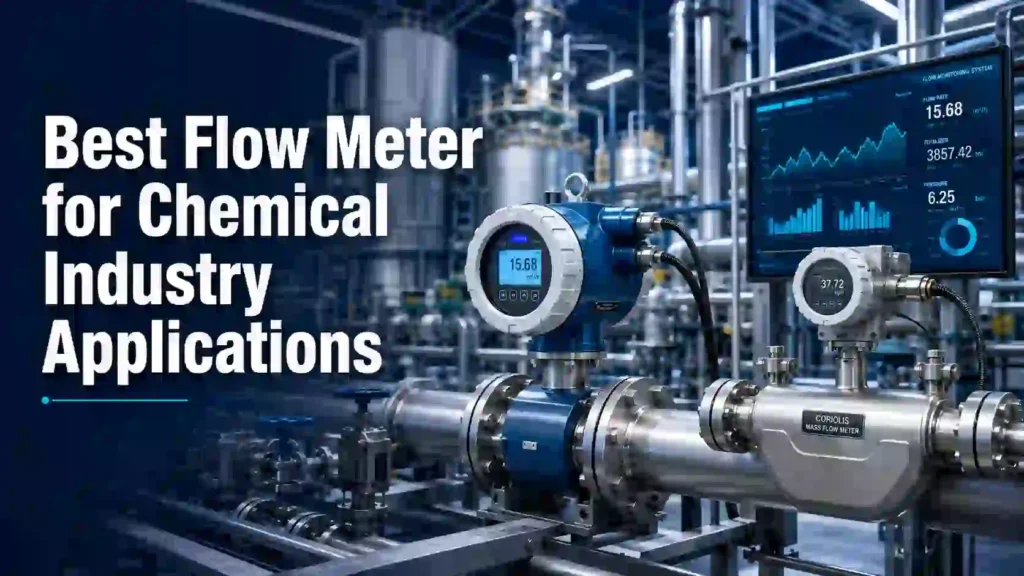
Accurate flow measurement is one of the most critical requirements in the chemical industry. Whether handling corrosive acids, aggressive solvents, specialty chemicals, or high-temperature process fluids, selecting the right flow meter directly impacts product quality, operational efficiency, and plant safety.
Chemical plants operate under demanding conditions where even minor measurement errors can lead to production losses, process inconsistencies, regulatory issues, and increased operating costs. Modern chemical process instrumentation relies on advanced industrial flow meters that can withstand harsh environments while delivering reliable and accurate performance.
With various technologies available, choosing the Best Flow Meter for Chemical Industry Applications requires understanding fluid characteristics, operating conditions, and process requirements. This guide explores the most widely used flow meter technologies and helps industries identify the most suitable solution for their chemical flow measurement needs.
Why Flow Meter Selection Matters in Chemical Processing
Selecting the right flow meter is more than a measurement decision—it is a key factor in overall process performance.
Improved Process Efficiency
Accurate flow data enables operators to optimize production processes, reduce waste, and maintain consistent throughput.
Better Product Quality
Precise flow measurement ensures correct chemical dosing, blending, and batching, resulting in consistent product quality.
Regulatory Compliance
Many chemical processes must comply with environmental and industry regulations. Reliable flow monitoring helps maintain compliance and supports reporting requirements.
Enhanced Worker Safety
Accurate monitoring reduces the risk of overflows, leaks, and unsafe operating conditions, protecting both personnel and equipment.
Reduced Operating Costs
Selecting the appropriate flow meter minimizes maintenance requirements, reduces downtime, and improves asset longevity.
Common Challenges in Chemical Flow Measurement
Chemical processing environments present several measurement challenges that influence flow meter selection.
- Corrosive chemicals that can damage sensor materials
- Abrasive slurries that cause wear and tear
- High-temperature applications requiring specialized construction
- High-pressure systems demanding robust designs
- Fluids with varying conductivity levels
- Maintenance concerns in continuous production environments
Understanding these challenges is essential when evaluating industrial flow monitoring solutions.
Best Flow Meter Technologies for Chemical Industry Applications
1. Electromagnetic Flow Meters
Electromagnetic flow meters, commonly called mag meters, operate based on Faraday’s Law of Electromagnetic Induction. As conductive liquids flow through a magnetic field, a voltage is generated and measured to determine flow rate.
Advantages
- No moving parts
- Excellent accuracy
- Minimal pressure loss
- Suitable for corrosive liquids
- Low maintenance requirements
Ideal Applications
- Acids
- Alkalis
- Conductive chemical solutions
- Water treatment chemicals
Suitable Chemicals
Electromagnetic flow meters are widely used for corrosive liquid measurement where conductivity levels are sufficient for operation.
2. Coriolis Mass Flow Meters
Coriolis flow meters measure mass flow directly by detecting changes in vibrating tubes caused by fluid movement.
Advantages
- Exceptional accuracy
- Direct mass flow measurement
- Simultaneous density measurement
- Suitable for complex chemical processes
Accuracy Benefits
Coriolis meters provide some of the highest accuracy levels available, making them ideal for critical dosing and batching applications.
Applications
- Chemical dosing
- Batch processing
- Specialty chemical production
- High-value chemical transfers
3. Vortex Flow Meters
Vortex flow meters measure flow by detecting vortices generated as fluid passes a bluff body.
Best Use Cases
- Utility systems
- Steam measurement
- Cooling water circuits
- Process gases
Advantages
- Durable construction
- Reliable performance
- Suitable for liquids, gases, and steam
Limitations
Performance may decrease at very low flow rates compared to other technologies.
4. Turbine Flow Meters
Turbine flow meters use a rotating rotor positioned within the flow stream. Flow velocity causes the rotor to spin, generating a signal proportional to flow rate.
Performance Characteristics
- High accuracy
- Fast response time
- Cost-effective solution
Suitable Chemical Applications
- Clean liquids
- Solvents
- Hydrocarbon-based chemicals
Accuracy Considerations
Turbine meters perform best with clean, low-viscosity fluids and require proper maintenance to ensure long-term accuracy.
5. Positive Displacement Flow Meters
Positive displacement flow meters measure flow by trapping and counting fixed volumes of liquid.
Benefits
- Excellent low-flow accuracy
- Suitable for viscous liquids
- Consistent performance
Typical Applications
- Resins
- Polymers
- Adhesives
- Specialty chemicals
These meters are particularly valuable where precise low-flow measurement is required.
6. Ultrasonic Flow Meters
Ultrasonic flow meters use sound waves to measure fluid velocity and flow rate.
Advantages
- Non-invasive measurement
- No moving parts
- Minimal maintenance
- Easy installation
Special Chemical Applications
Ultrasonic flow meters are ideal for large pipelines, temporary flow monitoring, and applications where pipe penetration is undesirable.
Comparison Table: Best Flow Meter Types for Chemical Industries
| Flow Meter Type | Accuracy | Best For | Maintenance | Chemical Compatibility |
| Electromagnetic Flow Meter | High | Conductive corrosive liquids | Low | Excellent |
| Coriolis Flow Meter | Very High | Dosing, batching, mass flow measurement | Low | Excellent |
| Vortex Flow Meter | Moderate to High | Steam, gases, utilities | Low | Good |
| Turbine Flow Meter | High | Clean chemical liquids | Moderate | Good |
| Positive Displacement Flow Meter | High | Viscous and low-flow chemicals | Moderate | Very Good |
| Ultrasonic Flow Meter | Moderate to High | Large pipelines and non-invasive measurement | Very Low | Good |
How to Choose the Best Flow Meter for Chemical Industry Applications
Choosing the right flow meter requires evaluating multiple process factors.
Chemical Compatibility
Verify that wetted materials can withstand exposure to the process fluid.
Fluid Conductivity
Conductive fluids are suitable for electromagnetic flow meters, while non-conductive fluids may require alternative technologies.
Flow Range
Ensure the selected meter can accurately measure expected minimum and maximum flow rates.
Process Temperature
High-temperature processes require specialized sensors and construction materials.
Pressure Rating
The flow meter must withstand maximum operating pressure conditions.
Installation Requirements
Available pipe length, orientation, and maintenance accessibility can influence meter selection.
Accuracy Requirements
Critical dosing and custody transfer applications often require higher-accuracy technologies such as Coriolis flow meters.
Maintenance Expectations
Facilities seeking reduced maintenance often prefer non-intrusive technologies with fewer moving parts.
Total Cost of Ownership
Consider installation, maintenance, calibration, and lifecycle costs rather than focusing solely on initial purchase price.
Recommended Flow Meter Solutions from IPS Automation
IPS Automation offers a comprehensive range of flow measurement solutions designed for demanding chemical industry applications, including:
- Electromagnetic Flow Meters
- Coriolis Flow Meters
- Vortex Flow Meters
- Turbine Flow Meters
- Paddle Wheel Flow Sensors
- Positive Displacement Flow Meters
With extensive expertise in chemical process instrumentation and industrial automation, IPS Automation helps customers evaluate process conditions and select the most suitable technology for accurate and reliable flow measurement.
Why Industries Choose IPS Automation
Chemical manufacturers rely on IPS Automation because of its commitment to performance, reliability, and technical support.
Technical Expertise
Experienced professionals provide application-specific guidance for flow meter selection.
Wide Product Portfolio
A broad range of industrial flow meters supports diverse chemical processing requirements.
Reliable Industrial Solutions
Products are selected to meet demanding industrial environments and long-term operational needs.
Process Automation Support
Integrated solutions help improve process control systems and plant efficiency.
Customized Application Guidance
Every process is unique, and IPS Automation delivers recommendations tailored to actual operating conditions.
Industry-Specific Recommendations
Solutions are designed to address the challenges of chemical manufacturing, processing, and plant automation.
Conclusion
Selecting the Best Flow Meter for Chemical Industry Applications requires careful consideration of fluid characteristics, operating conditions, process requirements, and long-term maintenance expectations. Technologies such as electromagnetic, Coriolis, vortex, turbine, positive displacement, and ultrasonic flow meters each offer unique advantages depending on the application.
There is no single flow meter that fits every chemical process. The ideal solution depends on factors such as chemical compatibility, conductivity, temperature, pressure, accuracy requirements, and total cost of ownership.
If you are looking for expert guidance on selecting the right flow measurement solution for your facility, contact IPS Automation today. Our specialists can help you identify the best flow meter technology for your chemical process and improve the accuracy, reliability, and efficiency of your operations.