

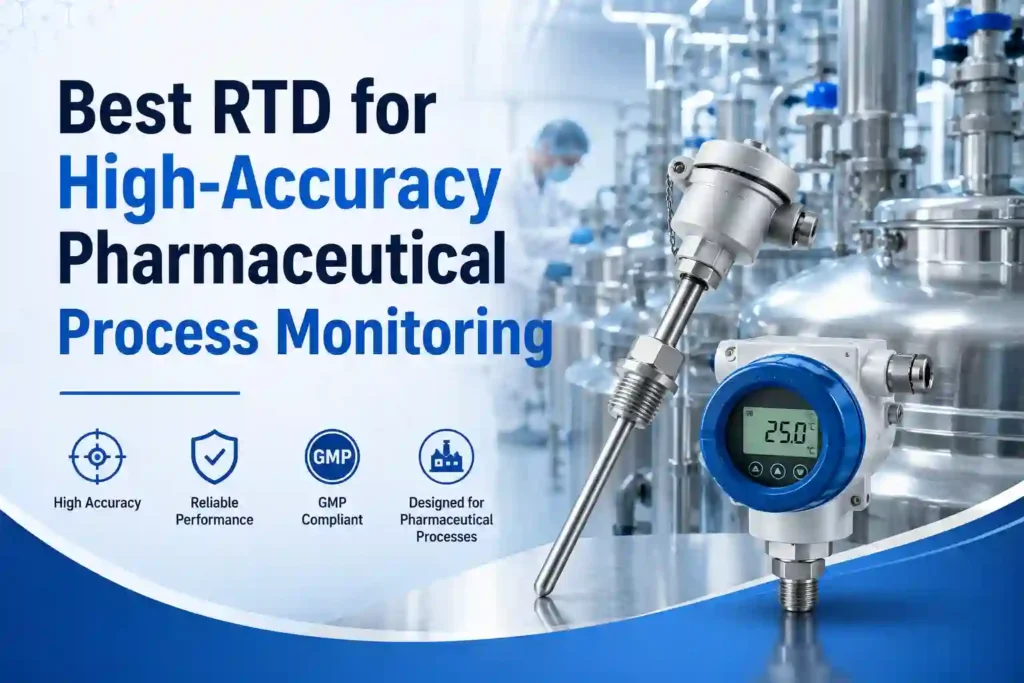
Temperature control is one of the most critical parameters in pharmaceutical manufacturing. From drug formulation and fermentation to sterilization and clean steam generation, maintaining precise temperatures is essential for ensuring product quality, process consistency, and regulatory compliance. Even minor temperature deviations can affect product efficacy, compromise batch integrity, and create challenges during validation and quality audits.
This is why selecting the Best RTD for High-Accuracy Pharmaceutical Process Monitoring is a key decision for pharmaceutical engineers and plant operators. Resistance Temperature Detectors (RTDs) are widely recognized for their accuracy, stability, and reliability, making them ideal for demanding pharmaceutical environments. In this article, we explore how RTD temperature sensors work, the features that matter most in pharmaceutical applications, and how to choose the right solution for high-accuracy process monitoring.
Why Accurate Temperature Monitoring Matters in Pharmaceutical Manufacturing
Pharmaceutical production relies heavily on controlled process conditions. Temperature is a critical variable that directly influences product quality and process performance.
Accurate temperature monitoring helps maintain batch consistency by ensuring that each production cycle operates within validated temperature limits. This consistency is essential for achieving uniform product quality across multiple batches.
Furthermore, pharmaceutical manufacturers must comply with Good Manufacturing Practice (GMP) requirements. Reliable temperature measurement supports process validation, documentation, and regulatory compliance. Many pharmaceutical processes, including sterilization and cleanroom operations, require strict temperature control to meet industry standards.
Inaccurate measurements can lead to product loss, process inefficiencies, failed validation procedures, and increased operational costs. Therefore, dependable temperature monitoring systems play a vital role in maintaining operational excellence.
What is an RTD Temperature Sensor?
An RTD (Resistance Temperature Detector) is a temperature sensor that measures temperature by monitoring changes in electrical resistance.
The operating principle is based on the predictable relationship between temperature and resistance. As temperature increases, the resistance of the RTD element also increases. This change is measured and converted into a temperature reading.
The most common RTD sensing elements are:
- Pt100 RTDs
- Pt1000 RTDs
Both use platinum as the sensing material because of its excellent stability, accuracy, and repeatability.
RTDs are often preferred for precision measurement applications because they provide highly accurate readings over a wide temperature range while maintaining long-term reliability.
Best RTD for High-Accuracy Pharmaceutical Process Monitoring: Key Features
Selecting the best RTD involves evaluating several critical performance characteristics.
High Measurement Accuracy
Pharmaceutical processes often require precise temperature control. High-accuracy RTDs provide reliable readings that support process validation, quality assurance, and regulatory compliance.
Excellent Repeatability
Repeatability ensures that the sensor consistently produces the same reading under identical process conditions. This characteristic is essential for batch-based pharmaceutical manufacturing.
Long-Term Stability
Temperature sensors used in pharmaceutical facilities must maintain accuracy over extended periods. Stable RTDs reduce calibration frequency and help maintain process reliability.
Fast Response Time
Many pharmaceutical processes involve rapid temperature changes. RTDs with fast response times enable operators to detect process variations quickly and make timely adjustments.
Hygienic and Sanitary Design
Pharmaceutical environments require equipment that supports hygienic operation. RTDs designed for sanitary applications help minimize contamination risks and support clean process requirements.
Corrosion Resistance
Exposure to cleaning agents, chemicals, and moisture demands durable sensor construction. Corrosion-resistant materials improve longevity and maintain measurement accuracy.
Compatibility with Temperature Transmitters
Modern process monitoring systems often integrate RTDs with temperature transmitters. This combination enhances signal integrity, improves process control, and supports automation systems.
Together, these features contribute significantly to pharmaceutical process reliability and operational efficiency.
RTD Types Commonly Used in Pharmaceutical Process Monitoring
Several RTD configurations are commonly used across pharmaceutical facilities.
Pt100 RTDs
Pt100 sensors are widely used because they offer excellent accuracy and industry-standard compatibility. They are suitable for a broad range of pharmaceutical applications.
Pt1000 RTDs
Pt1000 sensors provide higher resistance values, which can improve signal quality in certain installations and reduce the influence of lead wire resistance.
Thin-Film RTDs
Thin-film RTDs are compact, cost-effective, and provide fast response times. They are commonly used in general industrial and pharmaceutical process monitoring.
Wire-Wound RTDs
Wire-wound RTDs are known for superior accuracy and stability, making them ideal for critical measurement applications and validation processes.
Surface-Mounted RTDs
These sensors measure surface temperatures and are useful for monitoring equipment, vessels, and external process surfaces.
Insertion RTDs
Insertion RTDs are designed to measure the temperature of liquids, gases, and process media directly within pipelines, tanks, and reactors.
Selecting the Right RTD for High-Accuracy Pharmaceutical Monitoring
Choosing the appropriate RTD requires evaluating several important factors.
Required Accuracy Class: Higher accuracy classes are often necessary for critical pharmaceutical applications.
Process Temperature Range: The RTD must operate reliably across the expected temperature conditions.
Installation Requirements: Proper sensor placement influences measurement performance and response time.
Hygienic Process Connections: Sanitary designs are essential for pharmaceutical and clean-process environments.
Sensor Sheath Material: Material selection should provide chemical compatibility and corrosion resistance.
Response Time Requirements: Fast-changing processes may require sensors with quicker thermal response.
Calibration Considerations: Calibration capabilities support ongoing accuracy and validation requirements.
Environmental Conditions: Moisture, vibration, cleaning procedures, and operating environments should all be considered during sensor selection.
A careful evaluation of these factors helps ensure long-term measurement reliability.
The Role of Thermowells in Pharmaceutical Temperature Measurement
Thermowells play an important role in pharmaceutical temperature monitoring systems.
They provide mechanical protection for RTD sensors while allowing accurate temperature measurement within the process. Thermowells also improve process safety by creating a barrier between the sensor and process media.
One major advantage is simplified maintenance. Sensors can often be removed or replaced without interrupting the process, reducing downtime and maintenance costs.
Thermowells are commonly used in pharmaceutical systems, reactors, pipelines, and process vessels. IPS Automation provides thermowells and temperature measurement solutions designed to support industrial process monitoring requirements.
Industries and Pharmaceutical Processes That Benefit from High-Accuracy RTDs
High-accuracy RTDs are widely used throughout pharmaceutical manufacturing operations.
Common applications include:
- Bioreactors
- Sterilization systems
- Clean steam generation
- CIP (Clean-In-Place) processes
- SIP (Sterilize-In-Place) systems
- Vaccine manufacturing
- API production facilities
- Fermentation processes
- Laboratory validation systems
These applications demand reliable and repeatable temperature measurement to maintain process integrity and regulatory compliance.
Why Choose IPS Automation for Temperature Measurement Solutions
IPS Automation specializes in process instrumentation and industrial automation solutions that support accurate and reliable process monitoring.
The company offers precision-engineered RTD temperature sensors, thermowells, temperature transmitters, and process measurement solutions designed for industrial applications. With expertise across multiple industries, including pharmaceutical manufacturing, IPS Automation focuses on delivering dependable instrumentation solutions that support process control, operational efficiency, and measurement accuracy.
In addition, the company provides customized instrumentation solutions and works with globally recognized brands to address diverse industrial monitoring requirements.
Conclusion
Selecting the Best RTD for High-Accuracy Pharmaceutical Process Monitoring is essential for maintaining product quality, regulatory compliance, and process reliability. High-accuracy RTDs provide the precision, repeatability, and long-term stability required for critical pharmaceutical applications, from sterilization and fermentation to vaccine production and clean steam systems.
By carefully evaluating sensor accuracy, hygienic design, response time, and installation requirements, pharmaceutical facilities can improve process performance and reduce operational risks. Working with an experienced instrumentation provider is equally important for achieving dependable results. For reliable temperature measurement solutions, RTD sensors, thermowells, and process instrumentation support, contact IPS Automation to discuss your pharmaceutical process monitoring requirements.