

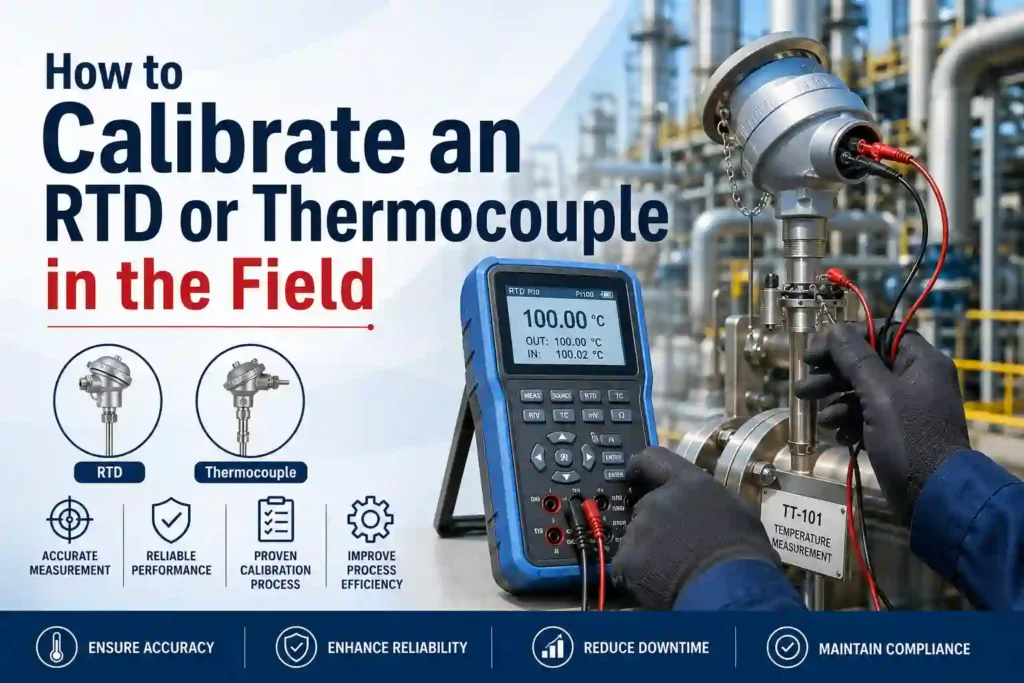
Accurate temperature measurement is essential for maintaining product quality, process efficiency, equipment safety, and regulatory compliance in industrial operations. Across industries such as chemical processing, pharmaceuticals, food manufacturing, power generation, and oil & gas, RTDs and thermocouples serve as critical components of industrial automation systems.
Over time, factors such as thermal cycling, vibration, aging, contamination, and harsh process conditions can cause temperature sensors to drift from their original accuracy. This drift can result in incorrect process decisions, reduced efficiency, product defects, and increased maintenance costs. That is why RTD and Thermocouple Calibration is a critical preventive maintenance activity that ensures reliable and accurate temperature measurements.
In this guide, we explain how to perform field calibration effectively while maintaining traceability and measurement integrity.
Understanding RTDs and Thermocouples
What is an RTD?
A Resistance Temperature Detector (RTD) measures temperature by correlating temperature changes with changes in electrical resistance. Platinum RTDs, particularly Pt100 sensors, are widely used due to their excellent accuracy and stability.
Advantages of RTDs:
- High accuracy
- Excellent repeatability
- Long-term stability
- Suitable for precise industrial temperature measurement
Common Applications:
- Pharmaceutical manufacturing
- Food processing
- Chemical plants
- HVAC systems
- Power generation facilities
What is a Thermocouple?
A thermocouple consists of two dissimilar metal conductors joined at one end. When exposed to temperature changes, the junction generates a small voltage proportional to temperature.
Common thermocouple types include:
- Type K
- Type J
- Type T
- Type N
- Type R and S
Advantages of Thermocouples:
- Wide temperature range
- Fast response time
- Rugged construction
- Cost-effective solution
Industrial Applications:
- Furnaces
- Boilers
- Heat treatment processes
- Kilns
- Petrochemical operations
RTD vs Thermocouple Comparison
| Parameter | RTD | Thermocouple |
| Accuracy | Very High | Moderate |
| Temperature Range | -200°C to 600°C | -200°C to 1800°C |
| Response Time | Moderate | Fast |
| Stability | Excellent | Good |
| Cost | Higher | Lower |
| Typical Applications | Precision process control | High-temperature processes |
RTD and Thermocouple Calibration: Why It Matters
Regular RTD and Thermocouple Calibration helps maintain measurement integrity and operational reliability.
Benefits include:
- Improved temperature measurement accuracy
- Better product quality assurance
- Enhanced process efficiency
- Regulatory compliance support
- Equipment protection
- Reduced downtime
- Increased process reliability
Even small temperature measurement errors can cause process deviations, increased energy consumption, safety concerns, and production losses. Calibration verifies sensor performance against traceable standards and identifies any drift before it impacts operations.
Tools Required for Field Calibration
Successful temperature sensor calibration requires the right equipment.
Essential Calibration Tools
Portable Temperature Calibrator
- Provides reference temperature signals for verification.
Dry Block Calibrator
- Generates stable temperatures for sensor testing in the field.
Precision RTD Simulator
- Simulates RTD resistance values for calibration checks.
Thermocouple Simulator
- Generates millivolt signals corresponding to thermocouple temperatures.
Digital Multimeter
- Measures resistance, voltage, and continuity.
Reference Temperature Sensor
- Provides traceable temperature measurements.
Calibration Documentation Sheet
- Records calibration results and maintains compliance records.
Modern process calibrators often combine multiple functions, allowing technicians to source and simulate RTD and thermocouple signals while automatically documenting calibration data.
Step-by-Step RTD Calibration Process
Step 1: Review Instrument Specifications
Verify sensor type, temperature range, tolerance requirements, and manufacturer recommendations before beginning the field calibration of RTD.
Step 2: Isolate the Sensor
Ensure the sensor is safely removed from process influence where possible. Follow plant lockout and safety procedures.
Step 3: Connect Calibration Equipment
Connect the RTD to a dry-block calibrator or precision RTD simulator according to manufacturer guidelines.
Step 4: Apply Reference Temperatures
Apply several temperature points across the operating range, such as:
- 0°C
- 100°C
- 200°C
- Process-specific temperatures
Allow sufficient stabilization time at each point.
Step 5: Compare Sensor Readings
Compare the RTD output with the reference temperature source and record deviations.
Step 6: Record As-Found Data
Document the sensor condition before any adjustment. This information is valuable for trend analysis and maintenance planning.
Step 7: Adjust if Necessary
If readings exceed acceptable tolerances, perform corrective adjustments according to manufacturer procedures.
Step 8: Verify and Record As-Left Data
Repeat testing after adjustments and document final results.
Practical Field Tips
- Use traceable calibration standards.
- Verify wiring integrity before testing.
- Allow adequate stabilization time.
- Follow site safety procedures.
- Maintain complete documentation for audit purposes.
A disciplined RTD calibration process ensures reliable long-term performance and measurement traceability.
Step-by-Step Thermocouple Calibration Procedure
The thermocouple calibration procedure differs slightly because thermocouples generate millivolt signals.
Sensor Inspection
Inspect the sensor for:
- Physical damage
- Corrosion
- Loose connections
- Insulation deterioration
Junction Verification
Verify that the measuring junction remains intact and free from contamination.
Temperature Simulation
Use a dry-block calibrator or thermocouple simulator to apply known temperature values.
Signal Verification
Measure output millivolts and compare them against standard thermocouple reference tables.
Error Analysis
Evaluate deviations throughout the operating temperature range.
Adjustment and Documentation
Adjust associated transmitters if necessary and document results.
Common Thermocouple Testing Methods
- Dry-block calibration
- Millivolt signal simulation
- Comparison calibration against a reference sensor
Common Field Challenges
- Incorrect thermocouple type selection
- Poor cold-junction compensation
- Electrical noise interference
- Loose wiring connections
Proper thermocouple testing practices help eliminate these issues and improve measurement confidence.
Common Calibration Mistakes to Avoid
Avoid these common errors during RTD and Thermocouple Calibration:
- Using uncalibrated reference equipment
- Ignoring sensor drift trends
- Incorrect wiring connections
- Skipping calibration documentation
- Insufficient stabilization time
- Using inappropriate reference temperatures
- Failing to verify post-adjustment results
These mistakes can compromise calibration accuracy and create false confidence in measurement performance.
Best Practices for Maintaining Temperature Measurement Accuracy
Maintaining long-term temperature measurement accuracy requires a proactive approach.
Recommended Best Practices
- Establish scheduled calibration intervals
- Implement preventive maintenance programs
- Inspect sensors routinely
- Verify proper installation practices
- Protect sensors from harsh environmental conditions
- Maintain calibration records
- Use reliable process instrumentation solutions
- Invest in high-quality industrial automation equipment
Regular temperature transmitter calibration should also be included as part of a comprehensive maintenance strategy.
Organizations that prioritize calibration achieve better process control, improved efficiency, and greater operational reliability.
Conclusion
Accurate temperature measurement is fundamental to safe and efficient industrial operations. Regular RTD and Thermocouple Calibration ensures sensors continue to provide dependable data for process control, product quality, and regulatory compliance.
By implementing structured calibration programs, maintaining traceable records, and following proven field procedures, facilities can improve process reliability, reduce downtime, lower maintenance costs, and enhance overall operational performance.
A proactive approach to calibration not only protects equipment and processes but also strengthens long-term productivity and profitability across industrial operations.
Need Reliable Temperature Measurement Solutions?
IPS Automation offers high-performance RTDs, thermocouples, temperature transmitters, thermowells, and advanced industrial automation solutions designed to deliver exceptional accuracy, reliability, and long-term performance.
Contact IPS Automation today to discuss the right temperature measurement solution for your application.