

Introduction
In modern industrial facilities, accurate pressure monitoring is essential for maintaining safe, efficient, and reliable operations. From monitoring filtration systems in water treatment plants to measuring flow rates in chemical processing units, understanding pressure differences helps engineers optimize performance, reduce energy consumption, and detect equipment issues before they become costly failures.
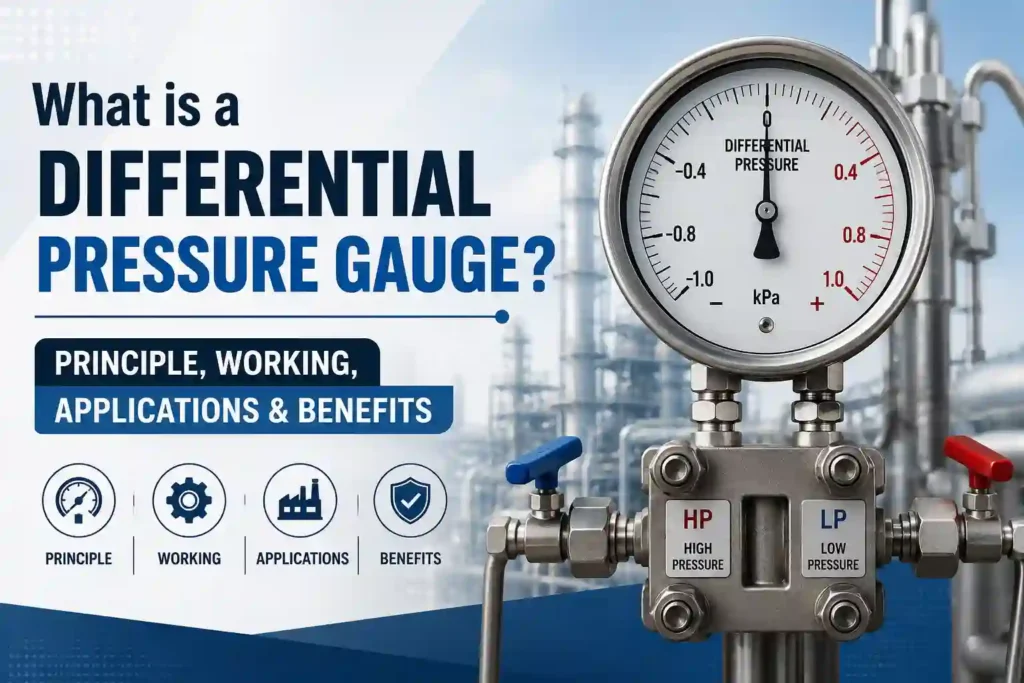
A Differential Pressure Gauge is one of the most widely used pressure measurement instruments in industrial process control. Unlike a conventional pressure gauge that measures pressure at a single point, a differential pressure gauge measures the pressure difference between two locations within a system. This capability makes it an indispensable tool for applications such as filter monitoring, flow measurement, level measurement, and pump performance analysis.
As a trusted provider of process instrumentation and industrial automation solutions, IPS Automation supplies high-quality differential pressure gauges and other precision-engineered instrumentation products to industries including Oil & Gas, Water Treatment, Chemical, Pharmaceutical, Food Processing, and Manufacturing.
What is a Differential Pressure Gauge?
A Differential Pressure Gauge (DP Gauge) is an industrial pressure measurement instrument designed to measure the difference between two pressure points within a closed process system.
Instead of displaying the absolute pressure at a single location, it continuously measures the pressure difference (ΔP) between a High Pressure (HP) port and a Low Pressure (LP) port.
This pressure difference provides valuable information about the operating condition of equipment and processes, making differential pressure measurement an essential part of industrial automation and process instrumentation.
What Does It Measure?
A differential pressure gauge measures:
- Pressure difference across filters
- Pressure drop in pipelines
- Flow rate (using primary flow elements)
- Tank level through hydrostatic pressure
- Pump and compressor performance
- Pressure loss in heat exchangers
- Blockages in process equipment
Because many industrial systems rely on pressure differences rather than absolute pressure values, DP gauges play a crucial role in maintaining process efficiency.
Why Do Industries Use Differential Pressure Gauges?
Industries use differential pressure gauges to:
- Monitor filter clogging
- Detect pressure losses
- Improve equipment efficiency
- Protect pumps and compressors
- Measure liquid levels
- Optimize industrial process control
- Reduce maintenance costs
- Improve plant safety
These gauges provide early warning signs of abnormal operating conditions, helping maintenance teams prevent unexpected downtime.
Pressure Gauge vs Differential Pressure Gauge
| Feature | Normal Pressure Gauge | Differential Pressure Gauge |
| Measures | Single pressure | Pressure difference |
| Pressure Ports | One | Two (HP & LP) |
| Typical Use | Tank pressure | Filters, flow, and level measurement |
| Applications | Basic pressure monitoring | Advanced process monitoring |
| Installation | Single connection | Dual process connections |
A standard industrial pressure gauge is ideal for measuring the pressure at one point in a system. In contrast, a differential pressure instrument compares two pressure points, providing deeper insights into system performance and enabling more advanced process monitoring.
How Does a Differential Pressure Gauge Work?
Differential Pressure Gauge Working Principle
The Differential Pressure Gauge Working Principle is based on measuring the difference between two independent process pressures.
The gauge consists of two pressure ports:
- High Pressure (HP) Port
- Low Pressure (LP) Port
These ports are connected to different points within the process system. The pressure difference between them acts on a sensing element inside the gauge, creating mechanical movement that is displayed on the dial.
Main Components
A differential pressure gauge typically includes:
- High Pressure (HP) connection
- Low Pressure (LP) connection
- Pressure sensing element
- Bourdon Tube, diaphragm, or bellows
- Mechanical linkage
- Pointer
- Calibrated dial
The choice of sensing element depends on the application, pressure range, accuracy requirements, and process conditions.
Step-by-Step Working Process
- High process pressure enters the HP port.
- Low process pressure enters the LP port.
- Both pressures act on the sensing element.
- The sensing element deflects according to the pressure difference.
- The movement is transferred through a mechanical linkage.
- The pointer moves across the calibrated dial.
- The dial displays the differential pressure value.
This simple yet effective mechanism enables continuous monitoring without requiring an external power supply, making mechanical differential pressure gauges highly reliable for industrial environments.
Pressure Sensing Elements
Different applications require different sensing technologies.
Diaphragm
A flexible diaphragm deforms when pressure differences are applied. This design offers excellent sensitivity and is widely used for low differential pressure applications.
Bellows
Bellows expand and contract with pressure variations, making them suitable for moderate differential pressure measurements where greater movement is required.
Bourdon Tube
Bourdon tubes are commonly used for higher pressure ranges and rugged industrial applications. They provide durability and long service life in demanding process environments.
How the Pointer Displays Pressure
As the sensing element moves, it drives a geared mechanism connected to the pointer. The pointer rotates proportionally to the pressure difference and indicates the measured value on a calibrated scale.
Operators can instantly determine whether:
- Filters are becoming clogged
- Pressure losses are increasing
- Pumps are operating efficiently
- Flow restrictions exist
- Equipment requires maintenance
This visual indication enables quick decision-making and helps maintain uninterrupted plant operations.
What is the Principle of a Differential Pressure Level Gauge?
A Differential Pressure Level Gauge measures liquid level by utilizing the hydrostatic pressure generated by the height of a liquid column.
The principle is based on the fact that the pressure exerted by a liquid increases proportionally with its height. As the liquid level rises inside a vessel or storage tank, the hydrostatic pressure at the bottom also increases. By measuring the pressure difference between the bottom and the top (or a reference point) of the tank, the gauge accurately determines the liquid level.
This method of differential pressure level measurement is widely used because it is reliable, cost-effective, and suitable for a broad range of industrial liquids.
Hydrostatic Pressure Principle
Hydrostatic pressure depends on three key factors:
- Liquid density
- Gravitational acceleration
- Height of the liquid
When the liquid level changes, the pressure difference changes proportionally. The differential pressure gauge converts this pressure difference into an easy-to-read level indication.
Differential Pressure Level Measurement Formula
ΔP=ρ×g×h\Delta P = \rho \times g \times hΔP=ρ×g×h
Where:
| Symbol | Meaning |
| ΔP | Differential Pressure |
| ρ (rho) | Liquid Density |
| g | Acceleration due to Gravity |
| h | Height of the Liquid |
How Changing Liquid Level Changes Pressure
Consider a storage tank:
- When the tank is nearly empty, the hydrostatic pressure at the bottom is low.
- As the tank fills, the liquid column becomes taller.
- The increased height produces greater hydrostatic pressure.
- The differential pressure gauge measures this change and converts it into an accurate level reading.
Because the measurement depends on liquid density, engineers should account for density variations when selecting or calibrating a differential pressure level gauge, particularly in applications involving temperature changes or different process fluids.
This principle makes differential pressure level measurement a dependable solution for closed tanks, pressurized vessels, and industrial storage systems where direct visual inspection is impractical.
Differential Pressure Gauge vs Differential Pressure Transmitter
Although both devices measure pressure difference, they serve different purposes in industrial process control.
| Feature | DP Gauge | DP Transmitter |
| Output | Mechanical | Electronic (4–20 mA/Digital) |
| Display | Analog Dial | Digital/Remote Display |
| Remote Monitoring | No | Yes |
| PLC/DCS Integration | No | Yes |
| Accuracy | High | Very High |
| Cost | Lower | Higher |
When Should You Choose a Differential Pressure Gauge?
A DP gauge is an excellent choice when:
- Local visual indication is sufficient.
- No PLC or SCADA integration is required.
- Simplicity and reliability are priorities.
- Maintenance costs need to be minimized.
- Power supply availability is limited.
When Should You Choose a Differential Pressure Transmitter?
A DP transmitter is more suitable when:
- Continuous remote monitoring is required.
- Integration with PLC, DCS, or SCADA systems is necessary.
- Process automation is a key objective.
- High measurement accuracy and data logging are important.
- Predictive maintenance strategies are being implemented.
While differential pressure gauges provide dependable local indication, differential pressure transmitters extend these capabilities by enabling real-time monitoring and integration into modern industrial automation and process control systems, making them ideal for digitally connected plants.
Applications of Differential Pressure Gauges
Differential pressure gauges are widely used across industries where monitoring pressure differences is critical for process efficiency, equipment protection, and product quality. They help engineers identify restrictions, monitor flow conditions, measure liquid levels, and ensure systems operate within safe limits.
Common Industrial Applications
1. Water Treatment Plants
In water treatment facilities, differential pressure gauges monitor pressure drops across sand filters, membrane filters, and cartridge filters. An increasing pressure difference indicates filter clogging, allowing maintenance teams to replace or clean filters before system performance declines.
2. Chemical Processing
Chemical plants use differential pressure measurement to monitor reactors, process vessels, and filtration systems. Accurate pressure monitoring ensures stable chemical reactions while improving process safety.
3. Pharmaceutical Manufacturing
Pharmaceutical industries rely on differential pressure gauges to maintain cleanroom environments and monitor HEPA filters. Maintaining the correct pressure differential prevents contamination and ensures compliance with stringent regulatory standards.
4. Oil & Gas Industry
In upstream, midstream, and downstream operations, differential pressure gauges are used to monitor pipelines, separators, filters, compressors, and flow measurement systems. They help detect blockages, pressure losses, and equipment inefficiencies before they become critical issues.
5. Boiler Systems
Boilers require continuous pressure monitoring to maintain efficient steam generation. Differential pressure gauges monitor feedwater systems, burner air filters, and steam flow, helping improve energy efficiency and operational safety.
6. HVAC Systems
Heating, Ventilation, and Air Conditioning (HVAC) systems use differential pressure gauges to monitor air filters, duct pressure, and airflow. Pressure differences indicate when filters require replacement, improving indoor air quality and reducing energy consumption.
7. Filtration Systems
Industrial filtration systems rely heavily on differential pressure gauges to determine filter condition. As contaminants accumulate, pressure drop increases, providing a clear indication that maintenance is required.
8. Pump Monitoring
Monitoring the pressure difference between the suction and discharge sides of a pump helps engineers evaluate pump efficiency, detect cavitation, and identify potential mechanical problems.
9. Heat Exchangers
Differential pressure gauges detect fouling and scaling inside heat exchangers. An increasing pressure drop often indicates reduced heat transfer efficiency, allowing maintenance before production is affected.
10. Storage Tanks
Differential pressure level gauges are commonly used for tank level measurement in closed and pressurized vessels, providing accurate and reliable level monitoring without direct contact with the liquid.
Applications by Industry
| Industry | Typical Application |
| Water Treatment | Filter Monitoring |
| Chemical | Reactor Pressure Monitoring |
| Pharmaceutical | Clean Room & HEPA Filter Monitoring |
| Oil & Gas | Pipeline & Separator Monitoring |
| Food & Beverage | Process Pressure Monitoring |
| Power Plants | Boiler & Steam System Monitoring |
Advantages of Differential Pressure Gauges
Differential pressure gauges provide reliable and cost-effective pressure monitoring for a wide range of industrial applications. Their robust mechanical design makes them suitable for harsh operating environments while delivering consistent performance over long service periods.
Key Benefits
| Benefit | Description |
| Accurate Measurement | Detects even small pressure differences with precision. |
| Reliable Operation | Rugged construction for demanding industrial environments. |
| Low Maintenance | Minimal moving parts reduce maintenance requirements. |
| Improved Safety | Helps identify blockages, pressure drops, and abnormal operating conditions. |
| Cost Effective | Reduces unplanned downtime and maintenance costs. |
Additional Advantages
- Continuous real-time pressure monitoring
- No external power supply required for mechanical models
- Long service life
- Suitable for harsh industrial environments
- Easy installation and operation
- Supports preventive maintenance programs
- Improves overall process efficiency
How to Select the Right Differential Pressure Gauge
Selecting the correct differential pressure gauge is essential for achieving accurate measurements, reliable performance, and long equipment life. The right selection depends on both the process conditions and the application’s operational requirements.
Important Selection Factors
Pressure Range
Choose a gauge with a measuring range suitable for both normal operating conditions and potential pressure fluctuations. Oversized or undersized gauges may reduce measurement accuracy.
Process Fluid
The compatibility of wetted parts with the process medium is critical. Corrosive or abrasive fluids may require stainless steel or specialized materials.
Operating Temperature
Ensure the gauge is rated for the expected process and ambient temperatures. Extreme temperatures can affect measurement accuracy and component life.
Material of Construction
Select materials that resist corrosion and withstand the operating environment. Stainless steel is commonly used in chemical, pharmaceutical, and food processing industries.
Accuracy Requirements
Critical industrial processes often require higher accuracy classes. Select a gauge that meets your application’s precision requirements.
Process Connection
Consider connection size, thread type, orientation, and installation location to ensure compatibility with existing piping systems.
Installation Environment
Outdoor installations, vibration, dust, humidity, and hazardous areas may require specialized gauges with protective enclosures or liquid-filled cases.
Differential Pressure Gauge Selection Checklist
✔ Required differential pressure range
✔ Process fluid compatibility
✔ Operating temperature
✔ Process pressure rating
✔ Accuracy class
✔ Dial size and readability
✔ Process connection type
✔ Wetted material compatibility
✔ Installation location
✔ Environmental conditions (dust, vibration, moisture)
✔ Industry standards and certifications
✔ Future maintenance accessibility
Following this checklist helps engineers select a differential pressure gauge that delivers accurate, reliable performance while minimizing maintenance and operational risks.
Why Choose IPS Automation?
Choosing the right instrumentation partner is just as important as selecting the right instrument. Reliable technical support, product quality, and application expertise contribute significantly to long-term operational success.
IPS Automation provides a comprehensive range of process instrumentation and industrial automation solutions designed to meet the needs of diverse industries, including Water Treatment, Oil & Gas, Chemical, Pharmaceutical, Food Processing, Power Plants, and Manufacturing.
Its portfolio includes:
- Differential Pressure Gauges
- Industrial Pressure Instruments
- Level Measurement Instruments
- Flow Measurement Solutions
- Temperature Measurement Instruments
- Industrial Analyzers
- Instrumentation Accessories
- Industrial Automation Solutions
In addition to supplying products from globally recognized brands, IPS Automation also offers in-house manufacturing capabilities, technical consultation, and customized instrumentation solutions tailored to specific industrial applications. This combination of product expertise and engineering support enables businesses to implement reliable and efficient measurement systems for demanding process environments.
Conclusion
A Differential Pressure Gauge is an essential instrument for accurately measuring pressure differences in industrial processes. Whether monitoring filter conditions, measuring liquid levels, evaluating pump performance, or protecting critical equipment, these instruments play a vital role in ensuring safe, efficient, and reliable plant operations.
Understanding the Differential Pressure Gauge Working Principle and the hydrostatic principle behind Differential Pressure Level Measurement helps engineers choose the right solution for their specific applications. From water treatment plants and chemical processing facilities to oil & gas installations and power plants, differential pressure gauges remain one of the most dependable pressure measurement instruments used in modern industrial automation.
If you’re looking for expert guidance in selecting the right Differential Pressure Gauge or other industrial instrumentation products, the engineering team at IPS Automation can help you identify solutions that match your process requirements and operational goals.
Frequently Asked Questions (FAQs)
1. What is a Differential Pressure Gauge?
A Differential Pressure Gauge is a pressure measurement instrument that measures the difference between two pressure points instead of measuring a single pressure value. It is commonly used for filter monitoring, flow measurement, and level measurement.
2. What is the principle of a Differential Pressure Level Gauge?
A Differential Pressure Level Gauge operates on the hydrostatic pressure principle, where the pressure generated by the height of a liquid column is measured using the formula ΔP = ρ × g × h.
3. Where are Differential Pressure Gauges used?
They are widely used in water treatment plants, chemical industries, pharmaceutical facilities, oil & gas operations, boilers, HVAC systems, filtration units, heat exchangers, storage tanks, and industrial process control systems.
4. What is the difference between a Pressure Gauge and a Differential Pressure Gauge?
A standard pressure gauge measures pressure at a single point, whereas a differential pressure gauge measures the pressure difference between two separate points within a system.
5. How accurate are Differential Pressure Gauges?
Accuracy depends on the gauge design, pressure range, and calibration. Industrial-grade differential pressure gauges provide reliable and repeatable measurements suitable for most process applications.
6. How do I choose the right Differential Pressure Gauge?
Consider factors such as differential pressure range, process fluid, operating temperature, material compatibility, accuracy, process connection, installation environment, and industry standards before selecting a gauge.