

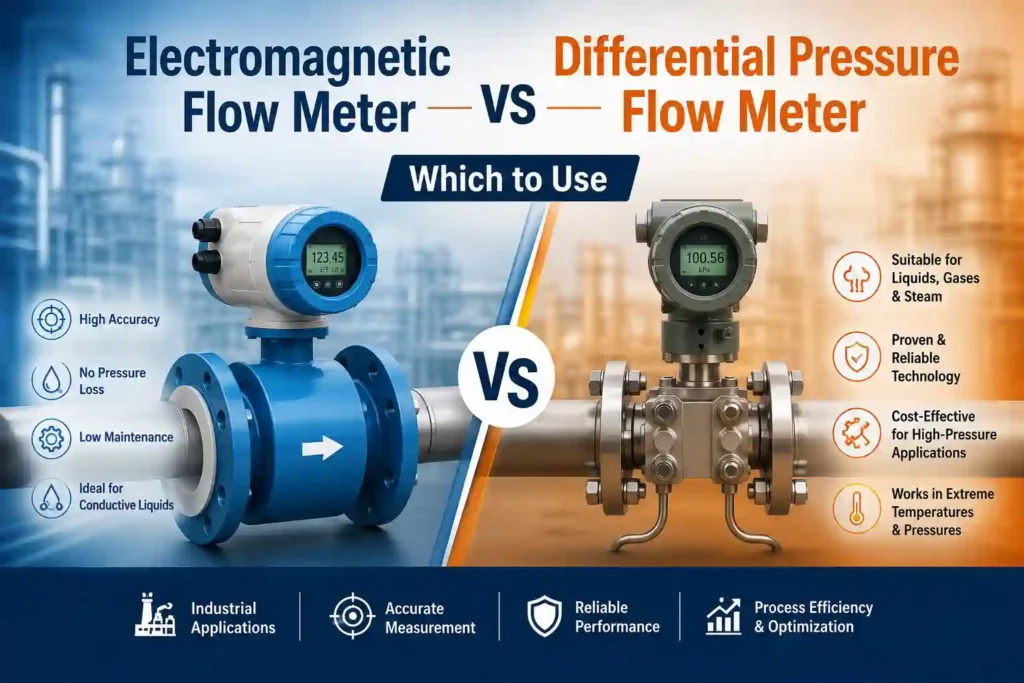
Selecting the right flow meter is essential for achieving accurate process control, minimizing maintenance costs, and improving operational efficiency. Among the most widely used technologies in industrial applications are Electromagnetic Flow Meters and Differential Pressure (DP) Flow Meters. While both measure flow rate, they operate on different principles and are designed for different process conditions.
In this guide, we’ll compare Electromagnetic Flow Meter vs Differential Pressure Flow Meter to help you determine which technology best suits your application.
Understanding Electromagnetic Flow Meters
An Electromagnetic Flow Meter, commonly called a Mag Meter, works based on Faraday’s Law of Electromagnetic Induction. As a conductive liquid flows through a magnetic field, it generates a voltage proportional to its flow velocity. The meter converts this voltage into an accurate flow measurement.
Key Advantages
- High measurement accuracy
- No moving parts, resulting in minimal maintenance
- No pressure loss due to unrestricted flow
- Ideal for corrosive and abrasive liquids
- Performs well with dirty fluids, slurries, and wastewater
Limitations
- Only works with electrically conductive liquids
- Cannot measure gases, steam, or hydrocarbons
- Higher initial investment compared to some flow meter technologies
Understanding Differential Pressure Flow Meters
A Differential Pressure Flow Meter measures flow by creating a restriction in the pipeline using devices such as an orifice plate, venturi tube, or flow nozzle. The pressure difference across the restriction is used to calculate the flow rate based on Bernoulli’s Principle.
Key Advantages
- Suitable for liquids, gases, and steam
- Proven technology with decades of industrial use
- Cost-effective for high-pressure applications
- Compatible with extreme temperatures and pressures
- Easy integration into existing industrial systems
Limitations
- Permanent pressure loss across the restriction
- Requires periodic maintenance and calibration
- Accuracy can be affected by wear and installation conditions
- Requires adequate straight pipe lengths for reliable measurement
Electromagnetic Flow Meter vs Differential Pressure Flow Meter: Key Differences
| Feature | Electromagnetic Flow Meter | Differential Pressure Flow Meter |
|---|---|---|
| Working Principle | Electromagnetic Induction | Pressure Difference |
| Suitable Fluids | Conductive Liquids | Liquids, Gases, Steam |
| Moving Parts | None | Primary element required |
| Pressure Loss | None | Yes |
| Maintenance | Low | Moderate |
| Accuracy | High | Good to High |
| Installation | Simple | Requires proper straight pipe lengths |
| Best For | Water, Chemicals, Slurries | Steam, Gas, High-pressure systems |
When Should You Choose an Electromagnetic Flow Meter?
An electromagnetic flow meter is the better choice when:
- Measuring water or wastewater
- Handling corrosive chemicals
- Monitoring slurry or pulp flow
- Reducing maintenance requirements
- Eliminating pressure loss in the pipeline
- Achieving high accuracy for conductive liquids
Industries including water treatment, food processing, pharmaceuticals, mining, and chemical processing frequently rely on magnetic flow meters.
When Should You Choose a Differential Pressure Flow Meter?
A differential pressure flow meter is ideal when:
- Measuring steam flow
- Monitoring compressed air or gases
- Operating under high pressure and temperature
- Retrofitting existing industrial installations
- Working with non-conductive fluids
DP flow meters are commonly used in power plants, oil & gas facilities, petrochemical industries, refineries, and utility systems.
Factors to Consider Before Selecting a Flow Meter
Before choosing between Electromagnetic Flow Meter vs Differential Pressure Flow Meter, consider the following:
- Type of fluid (conductive or non-conductive)
- Required measurement accuracy
- Operating temperature and pressure
- Maintenance expectations
- Installation constraints
- Pressure loss tolerance
- Long-term operating costs
Evaluating these factors ensures reliable performance and reduces unnecessary maintenance expenses over the equipment’s lifecycle.
Conclusion
When comparing Electromagnetic Flow Meter vs Differential Pressure Flow Meter, there is no universal solution. The right choice depends on your process requirements.
If you’re measuring conductive liquids and require high accuracy with minimal maintenance, an Electromagnetic Flow Meter is the preferred option. On the other hand, if your application involves steam, gases, or high-pressure fluids, a Differential Pressure Flow Meter remains one of the most dependable and cost-effective solutions.
At IPS Automation, we provide a comprehensive range of industrial flow measurement solutions designed to improve process efficiency, accuracy, and reliability. Our experts can help you select the ideal flow meter based on your specific application and operating conditions.
Need expert guidance? Contact IPS Automation today to find the right flow measurement solution for your industrial process.
FAQ
1. Which is more accurate: Electromagnetic Flow Meter or Differential Pressure Flow Meter?
Electromagnetic Flow Meters generally provide higher accuracy for conductive liquids because they measure flow directly without creating pressure loss.
2. Can an Electromagnetic Flow Meter measure gases?
No. Electromagnetic Flow Meters only work with electrically conductive liquids and cannot measure gases, steam, or non-conductive fluids.
3. Are Differential Pressure Flow Meters suitable for steam applications?
Yes. Differential Pressure Flow Meters are widely used for steam, gas, and high-pressure applications across power generation and industrial plants.
4. Which flow meter requires less maintenance?
Electromagnetic Flow Meters typically require less maintenance because they have no moving parts and do not create pipeline obstructions.