

Accurate chemical dosing is essential for maintaining process efficiency, equipment reliability, and product quality across industrial operations. Whether in water treatment, oil and gas, chemical processing, or pharmaceutical manufacturing, chemicals must be injected precisely into process pipelines without contamination or backflow. This is where what is a chemical injection quill with a check valve becomes an important question for engineers responsible for safe and reliable process control.
A chemical injection quill fitted with a check valve helps deliver treatment chemicals directly into the process stream while preventing reverse flow that could damage dosing equipment or contaminate chemical supply lines.
What is a Chemical Injection Quill with a Check Valve?
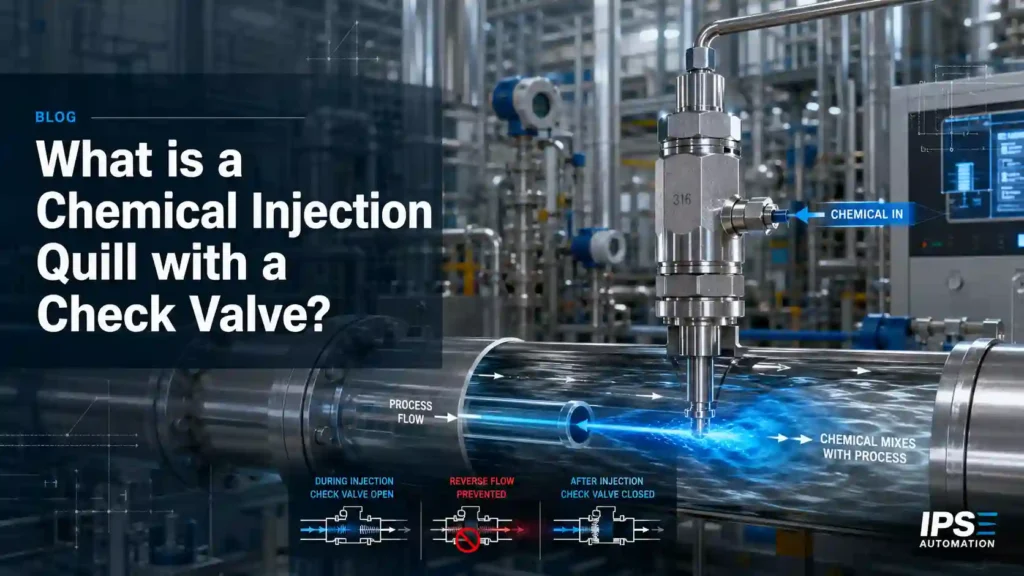
A chemical injection quill with a check valve is a process instrumentation component designed to inject chemicals safely and accurately into a pressurized pipeline. The quill extends into the center of the pipe, allowing chemicals to enter the flowing process fluid where mixing is more effective.
The integrated check valve permits flow in only one direction, preventing process media from flowing back into the chemical injection system.
Unlike a standard injection nozzle that releases chemicals near the pipe wall, an injection quill positions the injection point deeper inside the pipeline, resulting in:
- Better chemical distribution
- Improved mixing efficiency
- Reduced chemical wastage
- Lower risk of pipe wall corrosion
- Enhanced protection of dosing pumps
This design makes chemical injection quills a preferred solution in demanding industrial environments.
How Does a Chemical Injection Quill with a Check Valve Work?
The operating principle is straightforward but highly effective.
How Does a Chemical Injection Quill with a Check Valve Prevent Backflow?
- A dosing pump supplies chemical through the injection line.
- The chemical reaches the check valve.
- System pressure opens the spring-loaded check valve.
- The chemical flows through the injection quill.
- The nozzle injects the chemical into the center of the process pipeline.
- When injection stops, the spring immediately closes the check valve.
- Reverse flow from the process pipeline is blocked, protecting upstream equipment.
This one-way operation maintains chemical purity while preventing contamination and equipment damage.
Main Components
A chemical injection quill consists of several precision-engineered components:
- Injection Quill – Extends into the pipeline for effective chemical delivery.
- Check Valve – Prevents reverse flow into the chemical supply line.
- Nozzle Tip – Directs the chemical into the desired flow zone for optimal mixing.
- Spring Mechanism – Automatically closes the valve when injection pressure decreases.
- Body Material – Typically manufactured from SS316, Hastelloy, or other corrosion-resistant alloys depending on process conditions.
- Connection Type – Available in threaded, flanged, socket weld, or compression fittings.
- Sealing Components – PTFE, Viton, or other compatible seals ensure leak-free performance.
Selecting the appropriate material and sealing components is essential for long-term reliability.
Benefits of Using a Chemical Injection Quill with a Check Valve
| Benefit | Description |
|---|---|
| Prevents reverse flow | Stops process fluid from entering the chemical supply line. |
| Improves chemical mixing | Injects chemicals closer to the center of the flow stream. |
| Protects dosing equipment | Prevents damage to pumps and storage systems. |
| Reduces maintenance | Minimizes clogging, corrosion, and contamination. |
| Enhances safety | Reduces chemical exposure and leakage risks. |
| Improves process efficiency | Supports consistent chemical dosing and better process control. |
| Extends equipment life | Protects critical instrumentation and injection systems. |
Common Industrial Applications
Chemical injection quills with check valves are widely used in industries requiring accurate dosing and reliable process control, including:
- Oil & Gas production
- Chemical Processing plants
- Water Treatment facilities
- Desalination plants
- Petroleum Refineries
- Power Generation plants
- Pharmaceutical Manufacturing
- Food Processing industries
Typical applications include corrosion inhibitors, pH control chemicals, biocides, scale inhibitors, and chlorine dosing.
Installation Best Practices
Proper installation is essential for reliable performance.
Consider the following best practices:
- Position the quill at the recommended insertion depth.
- Verify compatibility between process chemicals and construction materials.
- Confirm that pressure and temperature ratings match operating conditions.
- Install the check valve in the correct flow direction.
- Perform leak testing before commissioning.
- Ensure sufficient clearance for inspection and maintenance.
- Follow manufacturer installation guidelines and plant safety procedures.
Correct installation improves chemical distribution while reducing maintenance requirements.
Maintenance Tips
Routine maintenance helps maximize service life and process reliability.
Recommended maintenance practices include:
- Inspect the quill for wear and corrosion.
- Clean the nozzle to prevent blockages.
- Test the check valve for proper one-way operation.
- Replace worn seals during scheduled maintenance.
- Inspect metallic components for corrosion or erosion.
- Conduct pressure testing after maintenance or replacement.
Preventive maintenance reduces unexpected downtime and extends equipment life.
How to Choose the Right Chemical Injection Quill with a Check Valve
Selecting the correct injection quill depends on several process parameters.
Evaluate:
- Operating pressure
- Operating temperature
- Pipeline diameter
- Chemical compatibility
- Construction material (SS316, Hastelloy, PTFE-lined options, etc.)
- Connection type
- Maintenance accessibility
Working with an experienced instrumentation supplier ensures the selected solution meets process requirements while maintaining long-term reliability and safety.
Conclusion
Understanding what is a chemical injection quill with a check valve helps engineers improve chemical dosing accuracy, enhance process safety, and protect valuable instrumentation. By combining precise chemical injection with dependable backflow prevention, these components play a vital role in modern industrial process systems.
If you’re looking for reliable chemical injection solutions or expert guidance on process instrumentation, IPS Automation can help you select high-quality products tailored to your application and operating conditions.
Frequently Asked Questions
1. Why is a check valve important in a chemical injection quill?
A check valve prevents reverse flow from the process pipeline into the chemical dosing system, protecting pumps, storage tanks, and chemical lines from contamination and damage.
2. Which materials are commonly used for chemical injection quills?
Common materials include SS316, Hastelloy, PTFE-lined components, and other corrosion-resistant alloys selected based on the chemical and operating environment.
3. Where are chemical injection quills most commonly used?
They are widely used in oil & gas, chemical processing, water treatment, desalination, pharmaceutical manufacturing, refineries, power plants, and food processing industries.