

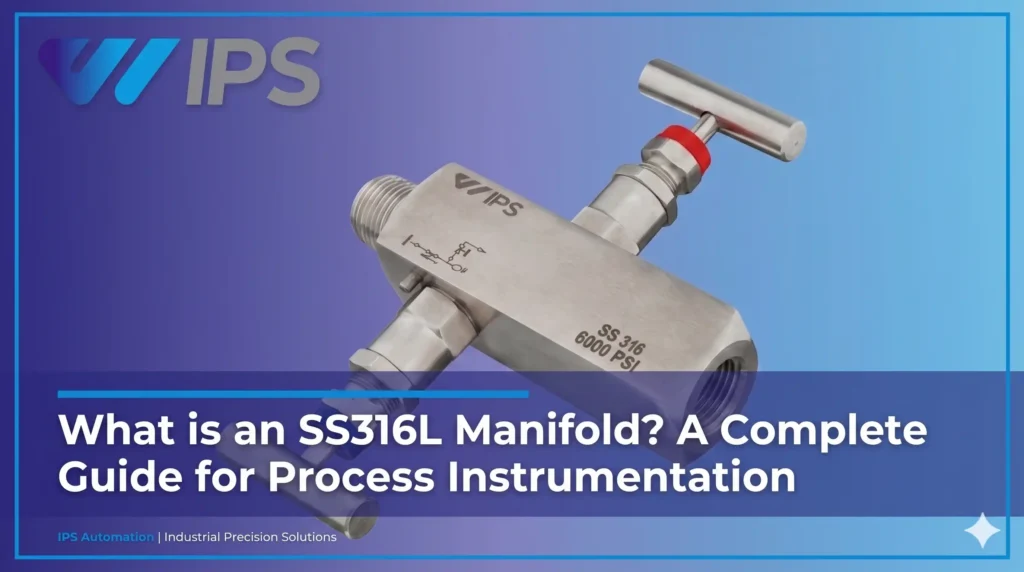
If you work with pressure gauges, pressure transmitters, or differential pressure (DP) transmitters, one component quietly makes your entire measurement loop safe, maintainable, and reliable: the SS316L manifold.
Whether you’re an instrumentation engineer specifying components for a new plant, or a maintenance professional replacing aging hardware, understanding what an SS316Lmanifold is — and how to choose the right valve block — is essential knowledge.
This complete guide covers everything: the material science, the valve configurations, the available connection sizes, and why SS316L remains the industry standard material of choice.
What Is aManifold in Process Instrumentation?
A manifold is a compact, multi-valve assembly that connects a process line to a pressure measuring instrument. Rather than using multiple individual valves spread across a piping system, this valve block integrates all necessary functions into a single, leak-minimizing body.
The core functions this instrument assembly performs are:
- Isolation — Shutting off the process from the instrument for safe removal or maintenance
- Bleed/Vent — Releasing trapped pressure or fluid from the instrument side
- Equalization — Balancing pressure across both legs of a DP transmitter during startup or calibration
- Calibration — Allowing instrument zero-checks and calibration without shutting down the process line
With threaded inlet and outlets, 2-valve assemblies have been the industry choice for “isolation and bleed” for various kinds of pressure gauges and transmitters. This speaks to a simple but important truth: these valve blocks are not accessories — they are a fundamental part of any safe instrumentation installation.
What Does SS316L Mean?
SS316L stands for Stainless Steel 316, Low Carbon:
- 316 — An austenitic stainless steel alloy that includes 2–3% molybdenum, giving it superior resistance to pitting and crevice corrosion compared to the more common 304 grade
- L — Low carbon content (≤ 0.03%), which prevents a phenomenon called sensitization during welding or high-temperature exposure
Why Low Carbon Matters
When standard 316 stainless steel is welded or exposed to temperatures between 425–860°C, carbon migrates to the grain boundaries and reacts with chromium — stripping the very element responsible for corrosion resistance. The L grade eliminates this risk, making it the correct choice for:
- Welded instrumentation assemblies
- CIP/SIP cleaning processes in pharma and food applications
- Aggressive chemical and chloride-rich environments
The result: an alloy that maintains its integrity throughout its service life, even in the harshest industrial conditions.
IPS Automation SS316L Valve Assembly: Available Versions & Specifications
IPS Automation offers SS316Lmanifold in three versions — 2-valve, 3-valve, and 5-valve — with connection sizes of 1/4″, 1/2″, and 1″. Available materials of construction include SS316L, Hastelloy, and Monel.
This material range is significant. While SS316L covers the vast majority of industrial applications, Hastelloy and Monel options ensure that even the most extreme chemical environments — concentrated acids, seawater immersion, or reducing atmospheres — can be accommodated without compromise.
The Three Valve Types Explained
2-Valve Configuration (Isolation & Bleed)
The simplest configuration, designed for use with gauge pressure transmitters and pressure gauges. It contains:
- 1 Isolation valve — Disconnects the instrument from the process
- 1 Bleed/vent valve — Releases pressure or drains fluid from the instrument side
The 2-valve configuration is the correct choice when you have a single-ended pressure measurement (gauge pressure) and need the ability to isolate and depressurize the instrument for safe maintenance without interrupting the process.
3-Valve Configuration (DP Transmitter Standard)
The most widely used configuration in differential pressure measurement. It features:
- 2 Isolation valves (high-pressure and low-pressure sides)
- 1 Equalizing valve — Connects both process legs to balance pressure before isolation
This configuration allows safe startup sequences, zero calibration under live process conditions, and complete isolation of the DP transmitter without shutting down the process line. It is the industry standard for flow, level, and differential pressure measurement using DP transmitters from brands like Honeywell STD 700, ABB 266DSH, and Endress+Hauser PMD.
5-Valve Configuration (High-Specification & Critical Service)
An extended 3-valve design with two additional vent/bleed valves — one on each process side. This configuration is preferred for:
- High-pressure and critical safety applications
- Processes where complete fluid drainage from both instrument legs is required
- Installations subject to frequent calibration or strict maintenance protocols
The 5-valve configuration provides maximum flexibility and safety redundancy, making it the specification of choice for oil and gas, power generation, and other safety-critical sectors.
Connection Sizes: 1/4″, 1/2″, and 1″
IPS Automation’s SS316Lmanifold are available in 1/4″, 1/2″, and 1″ connection sizes, covering the full range of typical instrumentation piping:
- 1/4″ NPT — The most common size for instrument impulse lines and direct-mount applications
- 1/2″ NPT — Used where higher flow capacity is required during venting or where process connection standards specify the larger bore
- 1″ — Applied in high-volume or larger-bore process connections, typically in heavy industry or flow measurement installations
Matching the correct connection size to your impulse line and transmitter process connection is a critical specification step that directly affects installation integrity and leak-tightness.
Why Choose SS316L Over Other Materials?
| Material | Best For | Limitation |
| SS316L | General industrial, chemical, pharma, oil & gas | Not suitable for concentrated HCl or HF |
| Hastelloy C-276 | Highly aggressive acids, oxidizing environments | Higher cost |
| Monel 400 | Hydrofluoric acid, seawater, reducing conditions | Limited availability |
For the majority of process plants, SS316L strikes the optimal balance between corrosion resistance, mechanical strength, weldability, cost, and industry acceptance. It meets the requirements of NACE MR0175 for sour service and is widely accepted under PED, ASME, and other international pressure equipment standards.
Industries That Rely on SS316L Manifold
- Oil & Gas — Wellhead instrumentation, separators, pipeline monitoring
- Petrochemical & Refining — Reactor pressure monitoring, heat exchanger DP measurement
- Pharmaceuticals — CIP/SIP-compatible installations with full material traceability
- Power Generation — Boiler drum level, steam flow, and turbine pressure measurements
- Water & Wastewater — Chemical dosing systems, pump differential pressure monitoring
- Food & Beverage — Hygienic pressure measurement loops
Checklist: Specifying Your SS316L Manifold
Before ordering, confirm the following:
- ✅ Valve configuration — 2-valve (gauge), 3-valve (DP), or 5-valve (critical service)?
- ✅ Connection size — 1/4″, 1/2″, or 1″?
- ✅ Material — SS316L standard; Hastelloy or Monel for extreme environments?
- ✅ Process pressure — Does the unit’s pressure rating exceed your system’s MAWP?
- ✅ End connection type — NPT, BSPP, or flanged?
- ✅ Mounting style — Direct-mount to transmitter or remote via impulse lines?
- ✅ Certifications required — NACE, PED, ATEX, SIL?
Conclusion
AnSS316L manifold is one of those components whose value is only fully appreciated when it’s absent — or wrong. Specified correctly, it gives your instrumentation loop safe isolation, reliable calibration capability, and decades of corrosion-free service.
IPS Automation’s range of SS316Lmanifolds — available in 2-valve, 3-valve, and 5-valve configurations, with 1/4″, 1/2″, and 1″ connections, and in SS316L, Hastelloy, and Monel — covers the full spectrum of process instrumentation requirements. Whether you’re building a new measurement loop or upgrading an existing installation, the right valve assembly starts with the right material.
Ready to specify your SS316Lmanifold?
Explore the full range at IPS Automation — Manifolds SS316L or contact the IPS team directly for technical support and custom requirements.
📞 +(91)-8447751125
📧 ipservices@ipsautomation.net
📍 Vikas Puri, New Delhi – 110 018, India