

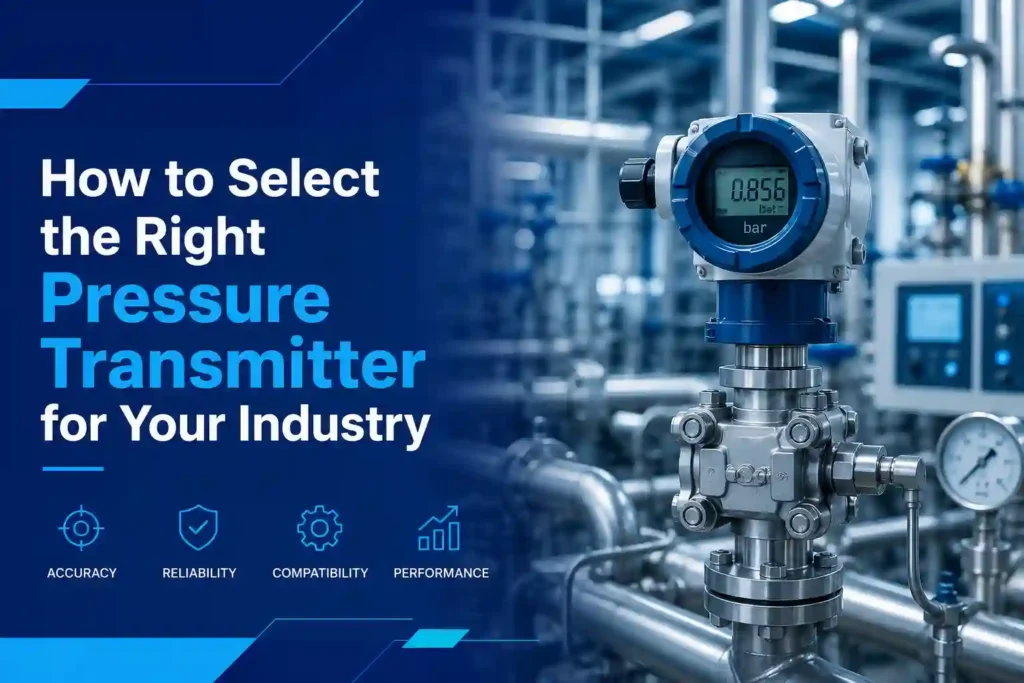
Pressure transmitters play a critical role in industrial automation, process control, and safety systems. From oil and gas plants to water treatment facilities and manufacturing industries, selecting the right pressure transmitter directly impacts operational efficiency, equipment safety, and production accuracy.
However, many industries struggle with choosing the correct pressure transmitter because of varying pressure ranges, harsh environmental conditions, fluid compatibility issues, and communication requirements.
In this guide, you will learn how to select the right pressure transmitter for your industry, the key factors to consider, common mistakes to avoid, and how the right selection can improve system performance and reduce maintenance costs.
What Is a Pressure Transmitter?
A pressure transmitter is an industrial instrument used to measure pressure in liquids, gases, or steam and convert it into an electrical signal for monitoring and control systems.
These transmitters are widely used in:
- Process industries
- Manufacturing plants
- HVAC systems
- Oil & gas operations
- Chemical processing
- Food and beverage industries
- Pharmaceutical production
- Water treatment plants
Pressure transmitters help operators monitor pressure levels accurately, automate processes, and maintain safe operating conditions.
Why Choosing the Right Pressure Transmitter Matters
Selecting the wrong pressure transmitter can lead to:
- Inaccurate readings
- Process instability
- Frequent equipment failure
- Increased maintenance costs
- Safety hazards
- Production downtime
The right transmitter ensures:
- Accurate pressure measurement
- Long-term reliability
- Better process control
- Improved equipment protection
- Reduced operational costs
Key Factors to Consider When Selecting a Pressure Transmitter
1. Understand Your Application Requirements
The first step is understanding where and how the pressure transmitter will be used.
Ask these questions:
- What medium is being measured?
- Liquid
- Gas
- Steam
- What is the operating pressure range?
- Is the process static or dynamic?
- Is the environment corrosive or hazardous?
- What level of accuracy is required?
Different industries require different transmitter specifications.
For example:
| Industry | Main Requirement |
| Oil & Gas | High durability and explosion protection |
| Water Treatment | Corrosion resistance |
| Food Industry | Hygienic design |
| Chemical Plants | Chemical compatibility |
| HVAC | Stable low-pressure measurement |
2. Select the Correct Pressure Range
Choosing the correct pressure range is one of the most important factors.
A pressure transmitter should operate within:
- Normal operating pressure
- Maximum pressure conditions
- Sudden pressure spikes
If the range is too high:
- Accuracy may decrease
If the range is too low:
- The sensor may get damaged
Best Practice
Choose a transmitter where the normal operating pressure falls between 30% and 70% of the full-scale range.
Example:
If your system usually operates at 6 bar, a 10 bar transmitter is typically a better choice than a 100 bar model.
Types of Pressure Measurement
Different applications require different measurement methods.
Gauge Pressure Transmitters
Measures pressure relative to atmospheric pressure.
Commonly used in:
- Pumps
- Compressors
- Hydraulic systems
Absolute Pressure Transmitters
Measures pressure relative to a perfect vacuum.
Used in:
- Vacuum systems
- Aerospace applications
- Scientific processes
Differential Pressure Transmitters
Measures the difference between two pressure points.
Widely used for:
- Flow measurement
- Filter monitoring
- Tank level monitoring
Sealed Pressure Transmitters
Uses a sealed reference pressure.
Suitable for:
- High-altitude applications
- Specialized industrial systems
Material Compatibility Is Critical
The transmitter material must be compatible with the process media.
If incompatible materials are used, it may cause:
- Corrosion
- Leakage
- Sensor failure
- Contamination
Common Wetted Materials
| Material | Suitable For |
| Stainless Steel | General industrial applications |
| Hastelloy | Corrosive chemicals |
| Monel | Marine environments |
| Tantalum | Highly aggressive acids |
For chemical industries, material selection becomes extremely important.
Consider Environmental Conditions
Industrial environments can be harsh.
You should evaluate:
- Ambient temperature
- Humidity
- Dust exposure
- Vibration
- Hazardous area classification
Hazardous Areas
Industries like oil & gas and chemical processing often require:
- Explosion-proof transmitters
- Intrinsically safe certifications
- ATEX or IECEx approvals
Using uncertified devices in hazardous environments can create major safety risks.
Accuracy and Performance Requirements
Not all industries require ultra-high accuracy.
For example:
| Application | Typical Accuracy Requirement |
| General HVAC | ±1% |
| Industrial Automation | ±0.5% |
| Chemical Processing | ±0.25% |
| Custody Transfer | ±0.1% |
Higher accuracy transmitters are usually more expensive, so choose based on actual operational needs.
Output Signal and Communication Protocols
Modern industries often integrate pressure transmitters with PLCs, SCADA systems, and industrial automation networks.
Common output signals include:
- 4–20 mA
- 0–10 V
- HART Protocol
- Modbus
- Profibus
Choosing the Right Communication Method
| Communication Type | Best For |
| 4–20 mA | Traditional industrial systems |
| HART | Smart diagnostics |
| Modbus | Digital communication |
| Profibus | Advanced automation systems |
If your facility uses industrial automation, compatibility with existing systems is essential.
Temperature Compensation Matters
Temperature changes can affect pressure measurement accuracy.
In high-temperature applications such as:
- Steam systems
- Boilers
- Chemical reactors
You may need:
- Temperature compensation
- Cooling elements
- Remote diaphragm seals
Ignoring temperature effects can lead to unstable readings and reduced transmitter lifespan.
Evaluate Process Connection Types
Pressure transmitters come with different connection types.
Common options include:
- Threaded connections
- Flanged connections
- Hygienic sanitary fittings
The correct connection depends on:
- Pipe size
- Industry standards
- Pressure rating
- Hygiene requirements
Food and pharmaceutical industries often require sanitary process connections for contamination-free operation.
Importance of IP Rating and Protection
Industrial transmitters are exposed to dust, water, and moisture.
Common protection ratings include:
| IP Rating | Protection Level |
| IP65 | Dust tight and water resistant |
| IP67 | Temporary water immersion |
| IP68 | Continuous immersion protection |
Outdoor and harsh industrial environments typically require IP67 or higher.
Common Mistakes to Avoid
Choosing Based Only on Price
Low-cost transmitters may fail faster and increase maintenance costs.
Ignoring Future Expansion
Always consider whether future automation upgrades may require digital communication support.
Overlooking Calibration Requirements
Some industries require regular calibration and compliance documentation.
Using Incorrect Wetted Materials
This is one of the leading causes of transmitter failure in chemical industries.
Industry-Specific Recommendations
Oil & Gas Industry
Recommended features:
- Explosion-proof design
- High-pressure capability
- Corrosion-resistant materials
Water Treatment Plants
Recommended features:
- Corrosion resistance
- Stable long-term operation
- Cost-effective maintenance
Food and Beverage Industry
Recommended features:
- Hygienic sanitary design
- Stainless steel body
- CIP/SIP compatibility
Chemical Industry
Recommended features:
- Chemical-resistant diaphragms
- High accuracy
- Advanced sealing systems
Benefits of Selecting the Right Pressure Transmitter
Choosing the correct transmitter offers several operational advantages:
- Improved process efficiency
- Reduced downtime
- Enhanced safety
- Better automation control
- Lower maintenance costs
- Longer equipment lifespan
- Accurate data monitoring
A properly selected pressure transmitter can significantly improve industrial productivity and reliability.
Selecting the right pressure transmitter is not simply about measuring pressure. It involves understanding your process conditions, environmental factors, industry standards, and automation requirements.
The ideal pressure transmitter should provide:
- Accurate measurement
- Reliable long-term performance
- Process compatibility
- Safety compliance
- Easy system integration
By carefully evaluating pressure range, material compatibility, environmental conditions, communication protocols, and industry-specific needs, businesses can improve operational efficiency while reducing maintenance and downtime.
Whether you operate in manufacturing, oil & gas, chemical processing, HVAC, or water treatment, investing in the right pressure transmitter is essential for safe and efficient industrial operations.