

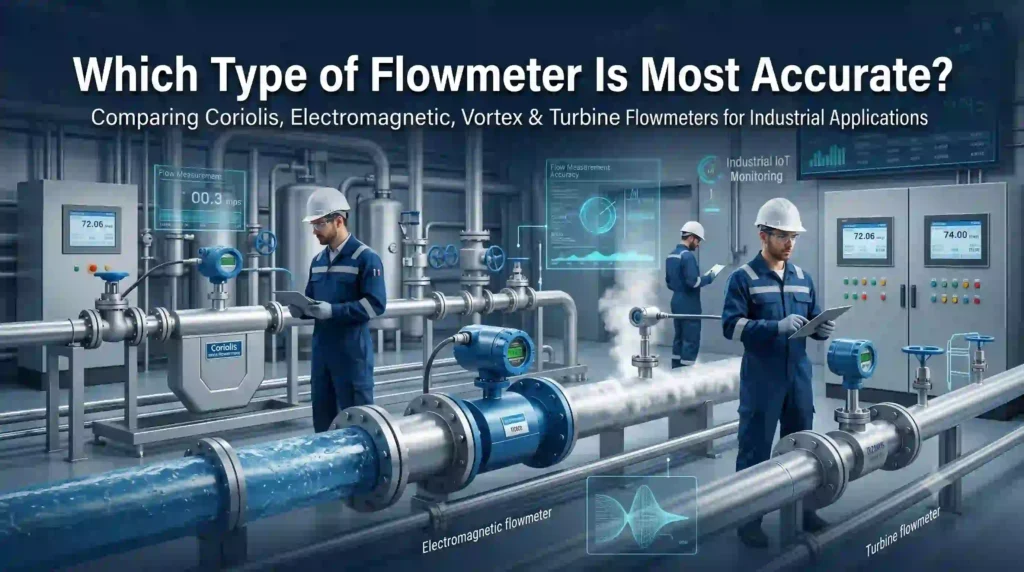
A small measurement error in a production plant can lead to thousands of dollars in product loss, inaccurate batching, compliance issues, or increased operational costs. Whether you’re managing a water treatment facility, chemical processing plant, food manufacturing unit, or refinery, accurate flow measurement is critical for maintaining efficiency and profitability.
This brings us to a common question asked by engineers and procurement teams alike: Which Type of Flowmeter Is Most Accurate?
The answer isn’t always straightforward. While some technologies are known for exceptional precision, the most accurate flow meter for one application may not be the best choice for another. Selecting the wrong flowmeter can result in inaccurate readings, unnecessary maintenance costs, and process inefficiencies.
In this guide, we’ll compare the leading flowmeter technologies and help you determine the best solution for your industrial flow measurement requirements.
Why Flowmeter Accuracy Matters in Industrial Processes
Flow measurement accuracy directly impacts several critical aspects of industrial operations.
Product Quality
In industries such as pharmaceuticals, chemicals, food processing, and manufacturing, precise flow control ensures consistent product quality. Even minor deviations can affect final product specifications.
Process Efficiency
Accurate flow data helps operators optimize processes, reduce waste, and improve throughput.
Cost Control
Measurement errors can lead to overuse of raw materials, excess energy consumption, and costly product losses.
Regulatory Compliance
Many industries must maintain accurate records of process parameters to comply with environmental and quality regulations.
Energy Management
Accurate flow monitoring helps organizations identify inefficiencies and reduce operating costs.
Simply put, improving flow measurement accuracy often delivers measurable financial and operational benefits.
Which Type of Flowmeter Is Most Accurate?
When discussing Which Type of Flowmeter Is Most Accurate?, several technologies deserve consideration. Each offers different advantages depending on the application, fluid characteristics, and operating conditions.
Coriolis Mass Flowmeters
Coriolis flowmeters are widely regarded as the gold standard for accuracy in industrial flow measurement.
Unlike many other technologies that infer flow indirectly, Coriolis meters directly measure mass flow by detecting changes in tube vibration caused by fluid movement.
Key Advantages
- Direct mass flow measurement
- Simultaneous density measurement
- High repeatability
- Excellent performance across varying process conditions
- Minimal dependence on fluid properties
Typical Accuracy
Many Coriolis meters offer accuracy levels of ±0.1% or better under ideal conditions.
Best Applications
- Chemical dosing
- Custody transfer
- Pharmaceutical manufacturing
- Food and beverage processing
- High-value liquids
When discussing Coriolis flow meter accuracy, few technologies can match its precision. However, higher purchase costs may not always justify the investment for simpler applications.
Electromagnetic Flowmeters
An electromagnetic flow meter measures flow based on Faraday’s Law of Electromagnetic Induction. These meters are highly reliable for conductive liquids.
IPS Automation supplies high-quality ABB Electromagnetic Flowmeters designed for demanding industrial environments.
Key Advantages
- No moving parts
- Low maintenance
- High reliability
- Excellent performance with dirty liquids
- Suitable for large pipe sizes
Typical Accuracy
Most electromagnetic flowmeters provide accuracy between ±0.2% and ±0.5%.
Best Applications
- Water treatment
- Wastewater systems
- Chemical processing
- Slurry applications
For many water and chemical applications, an electromagnetic flowmeter is often considered the best flow meter for liquids due to its balance of accuracy, reliability, and operating cost.
Turbine Flowmeters
Turbine flowmeters measure flow using a rotating rotor placed within the fluid stream.
Strengths
- High accuracy for clean liquids
- Fast response time
- Relatively lower cost
Limitations
- Moving parts can wear over time
- Sensitive to fluid contamination
- Requires regular maintenance
Typical Accuracy
Under ideal conditions, turbine flowmeters can achieve accuracy levels between ±0.25% and ±1%.
Best Applications
- Fuel monitoring
- Hydrocarbon measurement
- Clean liquid applications
While turbine meters can deliver excellent performance, their long-term accuracy often depends heavily on maintenance practices.
Vortex Flowmeters
Vortex flowmeters measure flow by detecting vortices generated as fluid passes around a bluff body.
Key Advantages
- Suitable for liquids, gases, and steam
- No moving parts
- Reliable long-term performance
Typical Accuracy
- Liquids: ±0.75% to ±1%
- Gases and steam: ±1% to ±1.5%
Best Applications
- Steam systems
- Compressed air monitoring
- Utility measurement
- Energy management systems
For steam applications, vortex flowmeters remain one of the most practical and dependable solutions available.
Factors That Affect Flowmeter Accuracy More Than the Meter Itself
Many engineers focus solely on the meter technology. However, installation and operating conditions often have a greater impact on accuracy than the meter itself.
Improper Installation
A high-end Coriolis meter can still provide inaccurate results if installed incorrectly.
Pipe Disturbances
Elbows, valves, and pumps located too close to the meter can create turbulent flow conditions.
Air Bubbles
Entrained air can significantly affect measurement accuracy, especially in liquid applications.
Calibration Issues
Even the most accurate flow meter requires periodic verification and calibration.
Wrong Technology Selection
Using a turbine meter for dirty wastewater or an electromagnetic meter for non-conductive fluids will inevitably create measurement problems.
Poor Maintenance
Build-up, wear, and process contamination can gradually reduce performance.
For example, a plant may invest in an expensive meter expecting exceptional results, only to discover that poor installation practices reduce accuracy by several percentage points.
How to Choose the Right Flowmeter for Your Application
The best approach to flow meter selection is to match the technology to the process requirements.
For Water Treatment
Recommended: Electromagnetic Flowmeter
Why:
- Excellent accuracy
- Handles dirty water
- Low maintenance
- No moving parts
For Chemical Dosing
Recommended: Coriolis Flowmeter
Why:
- Superior mass flow accuracy
- Density measurement capability
- Ideal for critical dosing operations
For Steam Applications
Recommended: Vortex Flowmeter
Why:
- Designed for steam measurement
- Reliable long-term performance
- Cost-effective solution
For Fuel Monitoring
Recommended: Turbine Flowmeter
Why:
- High accuracy with clean liquids
- Fast response
- Economical option
Choosing the correct technology often delivers better results than simply purchasing the highest-accuracy instrument available.
Common Mistakes Engineers Make When Selecting Flowmeters
Avoid these common errors during flow meter comparison and selection:
1. Selecting Based Only on Price
The cheapest option often leads to higher operating costs.
2. Ignoring Fluid Characteristics
Viscosity, conductivity, density, and temperature all influence meter performance.
3. Overlooking Installation Requirements
Insufficient straight pipe runs can negatively impact accuracy.
4. Choosing Excessive Accuracy
Not every application requires laboratory-level precision.
5. Neglecting Long-Term Maintenance Costs
A lower purchase price may result in higher maintenance expenses over time.
Working with experienced suppliers of industrial flow instruments can help avoid these costly mistakes.
Conclusion
So, Which Type of Flowmeter Is Most Accurate?
There is no single flowmeter that is the most accurate for every application. However, Coriolis flowmeters generally offer the highest measurement accuracy, while electromagnetic, vortex, and turbine flowmeters can deliver excellent results when matched to the correct process.
The key to successful industrial flow measurement is understanding your process requirements, installation conditions, maintenance capabilities, and performance expectations before making a decision.
Need help selecting the right flowmeter for your application? IPS Automation offers expert guidance and a complete range of industrial flow measurement solutions designed for accuracy, reliability, and long-term performance.