

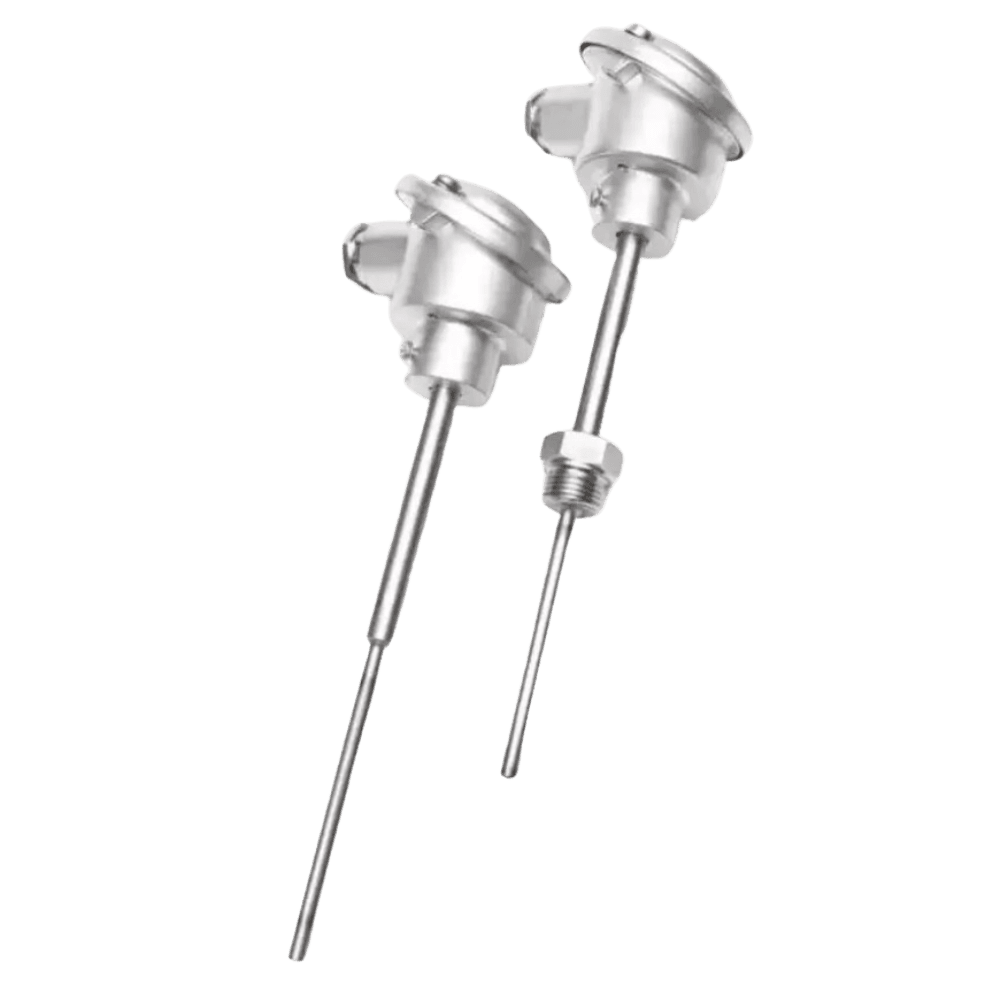
Accurate temperature monitoring is essential for safe and efficient industrial operations. From furnaces to pipelines and process plants, reliable sensing ensures consistent performance and product quality. Among temperature sensors used in industry today, Thermocouples are one of the most trusted and widely installed solutions due to their durability, fast response, and wide operating range.
This guide explains how Thermocouples work, their types, advantages, limitations, applications, and how to select the right model for industrial use.
What Are Thermocouples?
Thermocouples are temperature sensors made by joining two dissimilar metal wires to form a measuring junction. When exposed to temperature differences, they generate a small voltage proportional to the temperature variation.
Because they convert temperature into electrical signals without external power supply, they are considered active temperature transducers.
Key characteristics include:
- Simple construction
- Wide temperature measurement range
- Suitable for harsh environments
- Fast response time
- Reliable long-term performance
- Available in multiple industrial configurations
These features make Thermocouples ideal for continuous monitoring in demanding process conditions.
How Thermocouples Work
The working principle of Thermocouples is based on the Seebeck effect. When two different metals are joined and exposed to different temperatures at two junctions, a measurable voltage is produced.
This process involves:
- A measuring junction (hot junction)
- A reference junction (cold junction)
- Voltage signal generation
- Temperature conversion using instrumentation
The voltage generated is usually in millivolts and is interpreted by transmitters or controllers to display temperature readings accurately.
Because of this simple sensing mechanism, Thermocouples operate reliably even in vibration-prone industrial environments.
Types of Thermocouples
Industrial applications require different sensor materials depending on operating temperature and environment. IPS-type assemblies typically include base-metal and noble-metal sensor combinations.
Common Industrial Types
Type K
- Chromel–Alumel construction
- Suitable up to approx. 1200°C
- Most widely used general-purpose sensor
Type J
- Iron–Constantan combination
- Suitable up to approx. 1000°C
- Used in machinery and process plants
Type T
- Copper–Constantan construction
- Suitable for low-temperature applications
- Stable and cost-effective option
Type E
- High output voltage sensitivity
- Suitable for precision applications
Type R and S
- Platinum-based thermocouple types
- Used in high-accuracy furnace environments
Industrial assemblies are also available as:
- Angle-type sensors
- Bare wire elements
- Ceramic insulated elements
- MgO metal-sheathed sensors
- Multi-point measurement assemblies
These variations allow Thermocouples to support multiple installation conditions and process requirements.
Comparison Table: Common Types of Thermocouples
| Type | Material Combination | Temperature Range | Typical Application |
| K | Chromel–Alumel | Up to ~1200°C | General industry |
| J | Iron–Constantan | Up to ~1000°C | Machinery systems |
| T | Copper–Constantan | Up to ~350°C | Low-temperature monitoring |
| E | Chromel–Constantan | Up to ~850°C | Precision sensing |
| R/S | Platinum-based | Up to ~1400°C | Furnace processes |
Selecting the correct type improves the performance of Thermocouples in demanding applications.
Advantages of Thermocouples
Industries prefer Thermocouples because they provide strong performance across extreme process conditions.
Key advantages include:
- Wide temperature operating range
- Fast response speed
- Rugged mechanical construction
- Suitable for vibration environments
- Compatible with transmitters and controllers
- Available in customized probe designs
- Reliable performance in corrosive environments
Because of these advantages, Thermocouples remain one of the most practical industrial sensing solutions.
Limitations of Thermocouples
Although versatile, it have certain operational considerations.
Common limitations include:
- Lower accuracy compared to RTDs in some applications
- Requires reference junction compensation
- Signal drift possible in extreme environments
- Sensitive to electrical noise in long cable runs
Understanding these factors helps engineers select the correct sensor configuration.
Industrial Applications of Thermocouples
Due to their flexibility and durability, Thermocouples are widely used across process industries.
Typical applications include:
Process Industry
Used in:
- Chemical reactors
- Pipelines
- Storage vessels
Power Plants
Installed for monitoring:
- Boilers
- Turbines
- Exhaust systems
Oil and Gas Sector
Supports:
- Refinery temperature control
- Process monitoring
- Safety instrumentation
Furnace and Heat Treatment Systems
Used for:
- Kiln temperature measurement
- Metal processing
- High-temperature ovens
Plastic and Manufacturing Industry
Applied in:
- Extruders
- Injection molding machines
- Production heating zones
Because of this versatility, Thermocouples remain essential in industrial automation systems.
Tips for Selecting the Right Thermocouples
Selecting the correct sensor improves reliability and process performance.
Consider the following factors before choosing it
Temperature Range
Ensure compatibility with operating temperature limits.
Sheath Material
Select based on corrosion resistance and mechanical strength.
Sensor Type
Choose between:
- Base-metal sensors
- Noble-metal sensors
- MgO-sheathed assemblies
- Multi-point sensors
Installation Method
Match sensor design with:
- Immersion applications
- Surface mounting
- Angle-type installation
Accuracy Requirements
Select the correct tolerance class for your process.
Proper selection ensures long service life and accurate readings fromThermocouples.
Reliable temperature measurement is essential for efficient industrial operation. With their rugged design, wide operating range, and flexible installation options, it provide dependable performance across multiple industries.
By understanding sensor types, working principles, and installation requirements, engineers can select the right Thermocouples for safe, stable, and accurate process control.